Gdoc/Admin

Popular pages

Research and data to make progress against the world’s largest problems.

Read about our mission

Data Insights

Bite-sized insights on how the world is changing, published every few days.

See all Data Insights
The global average number of chickens eaten per person continues to grow.

Line chart of per capita chicken meat supply per person per year from 1961 to 2023, showing a steady upward trend. The subtitle explains this measures the amount of meat available for consumption per person per year. The line starts at about 2 chickens per person in 1961, passes about 5 chickens by 1990, and reaches about 9 chickens by 2022 to 2023. X axis labeled with years from 1961 to 2023; y axis from 0 to 10 chickens. Annotated callouts note: "In 1961, 2 chickens per person were killed for meat globally," "By 1990, this had more than doubled to 5 chickens," and "By 2022, it had risen to 9 chickens." Data source: Food and Agriculture Organization of the United Nations (2025) CC BY.

Global chicken consumption per person has quadrupled since 1961

In 1961, around two chickens were slaughtered per person globally each year. As many countries grew richer — and richer countries tend to eat more meat — global demand for chicken increased.

Since then, the number of chickens slaughtered per person has quadrupled. On average, 9 chickens are killed each year for every person in the world. Chickens have also become much heavier, so the amount of meat eaten in kilograms has grown even faster.

Life is short and painful for many farmed animals. Global estimates suggest that most are raised in factory farms. In the United States, around 99% of livestock comes from them.

Explore more interactive charts and articles on animal welfare on our dedicated topic page.
Continue reading
How many lives would be saved if Africa had other regions’ child mortality rates?
Subtitle: Hypothetical number of children dying before the age of five in 2023.

Summary: Africa currently has 2,840,000 under-five deaths; if it had Europe’s child mortality rate that would fall to 200,000, saving 2,640,000 lives.

Tiles:
- Child deaths in Africa today: 2,840,000 deaths.
- If Africa had the child mortality rate of Asia: 960,000 deaths, 1,880,000 lives saved.
- South America: 690,000 deaths, 2,150,000 lives saved.
- Oceania: 650,000 deaths, 2,190,000 lives saved.
- North America: 480,000 deaths, 2,360,000 lives saved.
- Europe: 200,000 deaths, 2,640,000 lives saved.

Data source: Author calculations based on UN IGME (2025). License: CC BY.

How many lives would be saved if Africa had other regions’ child mortality rates?

One of the starkest expressions of global inequality is a child’s chance of survival. In 2023, 2.84 million children in Africa died before reaching their fifth birthday, giving the continent the highest child mortality rate of any region (5.9%).

The chart above shows a simple hypothesis: how many more African children would reach the age of five if it had the same child mortality rates as other regions?

If conditions in Africa improved enough to match Asia’s current child mortality rate (2%), 1.9 million of these 2.84 million children would survive.

If the child mortality rate were to drop to the European rate (0.4%), then 2.64 million children would be saved each year.

To learn more, read my colleague Max’s article on the progress made in reducing child mortality.
Continue reading
Most homicide victims in the United States are men, but women face higher risk from partners

Two horizontal stacked bar charts comparing perpetrator categories for male and female homicide victims. Top chart labeled "Male victim" shows three segments labeled Partner, Family, and Other (acquaintances, strangers); the total male homicide rate is 5.4 deaths per 100,000 in 2023, with the Other category making up the largest share, family a smaller share, and partner the smallest. Bottom chart labeled "Female victim" shows three segments labeled Partner, Family, and Others; the total female rate is 2 deaths per 100,000, with the partner category a much larger share of female victims than it is for male victims. Key insight: American men are 2.7 times more likely to die from homicide than women, while women face relatively higher risk from partners. Data source: UN WPP (2024); UN ODC (2025). Note: The perpetrator of homicides is not always recorded, therefore the values shown may be an underestimate. License: CC BY.

American homicide victims are mostly men, except when the killer is an intimate partner

Almost 20,000 Americans were murdered in 2023.

The chart shows the homicide rates among male and female victims. Men were 2.7 times more likely to die by homicide than women.

We can see that for men, most of these murders were committed by friends, neighbors, acquaintances, or strangers (shown as “Other” in the chart) rather than a partner or family member. The opposite is true for women: intimate partners are the biggest threat.

Because the risks are different, the most effective responses may differ too. For women, reducing intimate partner violence is a key priority. For men, prevention is more often tied to crime, gangs, and violence among acquaintances or strangers.

Explore homicide rates for more countries.
Continue reading
China’s fertility rate has fallen to one, continuing a long decline that began before and continued after the one-child policy.

Line chart of China’s total fertility rate from 1950 to 2023, vertical axis labeled 0 to 7 births per woman. The chart shows a peak near 7 births per woman in the mid-1960s, followed by a sharp decline through the 1970s. The one-child policy is annotated as being rolled out in 1980 when the rate was already around 3 births per woman. After 1980 the rate continues downward, falling below 2 births per woman around the 1990s and staying at or below replacement level thereafter.

Data sources in the footer: Human Fertility Database; UN WPP (2024).

China’s fertility rate has fallen to one, continuing a long decline that began before and continued after the one-child policy

The 1970s were a decade shaped by fears about overpopulation. As the world’s most populous country, China was never far from the debate. In 1979, China designed its one-child policy, which was rolled out nationally from 1980 to curb population growth by limiting couples to having just one child.

By this point, China’s fertility rate — the number of children per woman — had already fallen quickly in the early 1970s, as you can see in the chart.

While China’s one-child policy restricted many families, there were exceptions to the rule. Enforcement differed widely by province and between urban and rural areas. Many couples were allowed to have another baby if their first was a girl. Other couples paid a fine for having more than one. As a result, fertility rates never dropped close to one.

In the last few years, despite the end of the one-child policy in 2016 and the government encouraging larger families, fertility rates have dropped to one. The fall in fertility today is driven less by policy and more by social and economic changes.

This chart shows the total fertility rate, which is also affected by women delaying when they have children. Cohort fertility tells us how many children the average woman will actually have over her lifetime. In China, this cohort figure is likely higher than one, but still low enough that the population will continue to shrink.

Explore more insights and data on changes in fertility rates across the world.
Continue reading
Respiratory death rates from seasonal flu in older adults. World map showing estimated annual respiratory flu deaths per 100,000 people among adults aged 65+, average for the period 2002 to 2011. Highest rates are concentrated across much of sub-Saharan Africa, parts of South America (notably the southern cone), and South and Southeast Asia; lowest rates occur across Western Europe, North America, Russia, and Australia. Legend shows values from 0 to 90 per 100,000 in 10-unit increments; hatched areas indicate no data for some countries. Data source: Global Pandemic Mortality Project II (2019). License: CC BY. Note: Estimates do not include deaths from other complications of the flu, for example cardiovascular disease. Averages exclude the 2009 Swine flu pandemic.

Seasonal flu kills about 700,000 people each year across the world

Seasonal influenza is sometimes seen as a mild illness, but it remains a major cause of death. In serious cases, it can cause deadly complications such as pneumonia, strokes, and heart attacks. Researchers estimate that the flu causes about 400,000 respiratory deaths and 300,000 cardiovascular deaths globally each year.

The flu is most dangerous for infants and older adults. The map here shows rates of respiratory deaths caused by the flu in adults aged 65 and over, averaged across 2002–2011 (excluding the 2009 Swine Flu pandemic).

The data shows that death rates tend to be higher in South America, Africa, and South Asia than in Europe or North America.

I come from South America, and I found this surprising: most of what I hear about flu deaths tends to come from richer countries in the Northern Hemisphere. But the map shows that the flu is also deadly, in some cases even more so, in other regions where poverty, worse underlying health, limited access to healthcare, and lower vaccination coverage contribute to higher mortality.

One explanation for my misperception might be that surveillance and reporting are stronger in the countries that I associate with deaths from flu. Another could also be age differences: people in high-income countries tend to be older, so their total number of deaths — the ones you actually hear about — may still be higher, even if rates are lower.

When you consider the total death toll, you realize that the numbers are very large on the whole. Recall that the map only includes respiratory deaths, so the overall mortality is actually higher if we include other flu-related complications like cardiovascular disease.

Even if you account for the uncertainty of estimates in low-income countries — due to limited testing and death registration — the overall pattern remains striking: seasonal influenza kills hundreds of thousands each year, with many of these deaths in South America, Africa, and South Asia.

Read more in our article, “How many people die from the flu?”
Continue reading
Afghans say they are the least satisfied with their lives. Horizontal bar chart of average self-reported life-satisfaction ladder scores where 10 is the best possible life and 0 the worst. Highest scores: Finland 7.7, Denmark 7.5, Iceland 7.5, Sweden 7.3. Global average 5.3. Lowest scores: Malawi 3.3, Lebanon 3.2, Sierra Leone 3.0, Afghanistan 1.4. Data source: Wellbeing Research Centre (2025). Chart licensed CC BY to Our World in Data

Afghans report the lowest life satisfaction in the world

Measuring happiness is difficult, but one way to understand how satisfied people are with their lives is to simply ask them.

Self-reported life satisfaction is one key metric that researchers often rely on. It asks people to imagine a hypothetical ladder, where the best possible life for them is a 10, and the worst possible life is a 0. They then have to place their current position on the ladder.

The chart shows the three-year average scores from 2022 to 2024 for the four countries with the highest ratings and the four with the lowest.

Afghans reported the lowest life satisfaction in the world, far below any other country.

This incredibly low score has been replicated in other studies. Researchers recently compared Afghans’ life satisfaction with international datasets dating back to 1946 and found it was the lowest ever recorded. Two-thirds gave a score of 0 or 1 on the 10-point scale.

See self-reported levels of life satisfaction in your own country.
Continue reading
The image presents a bar graph titled "Women are the victims in most partner homicides." It compares the percentages of male and female victims of partner homicides across a selection of 9 OECD countries.

The countries listed include the United States, Canada, Netherlands, United Kingdom, France, Spain, Germany, Switzerland, and Italy.

The exact percentages vary, but for all countries, women are much more likely than men to be killed by their intimate partner

The data sources for this graph are the United Nations World Population Prospects from 2024 and the United Nations Office on Drugs and Crime from 2025. The graph is licensed under Creative Commons Attribution to Our World in Data.

Women are more likely to be victims of partner homicide

Women are much more likely than men to be killed by their intimate partner. The chart shows this across nine OECD countries in 2023.

These deaths are rarely isolated events. Research shows that partner homicides are usually the endpoint of a long pattern of coercive control — behaviors such as surveillance, isolation, intimidation, restrictions on daily life, and physical violence.

Recognizing both the gender imbalance and its roots in coercive control can help focus support services, encourage family and friends to act sooner, and increase social pressure against abusive behavior.

While women face the highest risk from intimate partners, men make up about 80% of homicide victims globally. The gender split in partner homicides is therefore a striking exception.

Explore more data on homicide rates where the perpetrator is an intimate partner.
Continue reading

Explore our data

Featured data from our collection of 13,789 interactive charts.

See all our data

What share of children die before their fifth birthday?

What could be more tragic than the death of a young child? Child mortality, the death of children under the age of five, is still extremely common in our world today.

The historical data makes clear that it doesn’t have to be this way: it is possible for societies to protect their children and reduce child mortality to very low rates. For child mortality to reach low levels, many things have to go right at the same time: good healthcare, good nutrition, clean water and sanitation, maternal health, and high living standards. We can, therefore, think of child mortality as a proxy indicator of a country’s living conditions.

The chart shows our long-run data on child mortality, which allows you to see how child mortality has changed in countries around the world.

Explore the data
Explore the data

Share of population living in extreme povertyWorld Bank

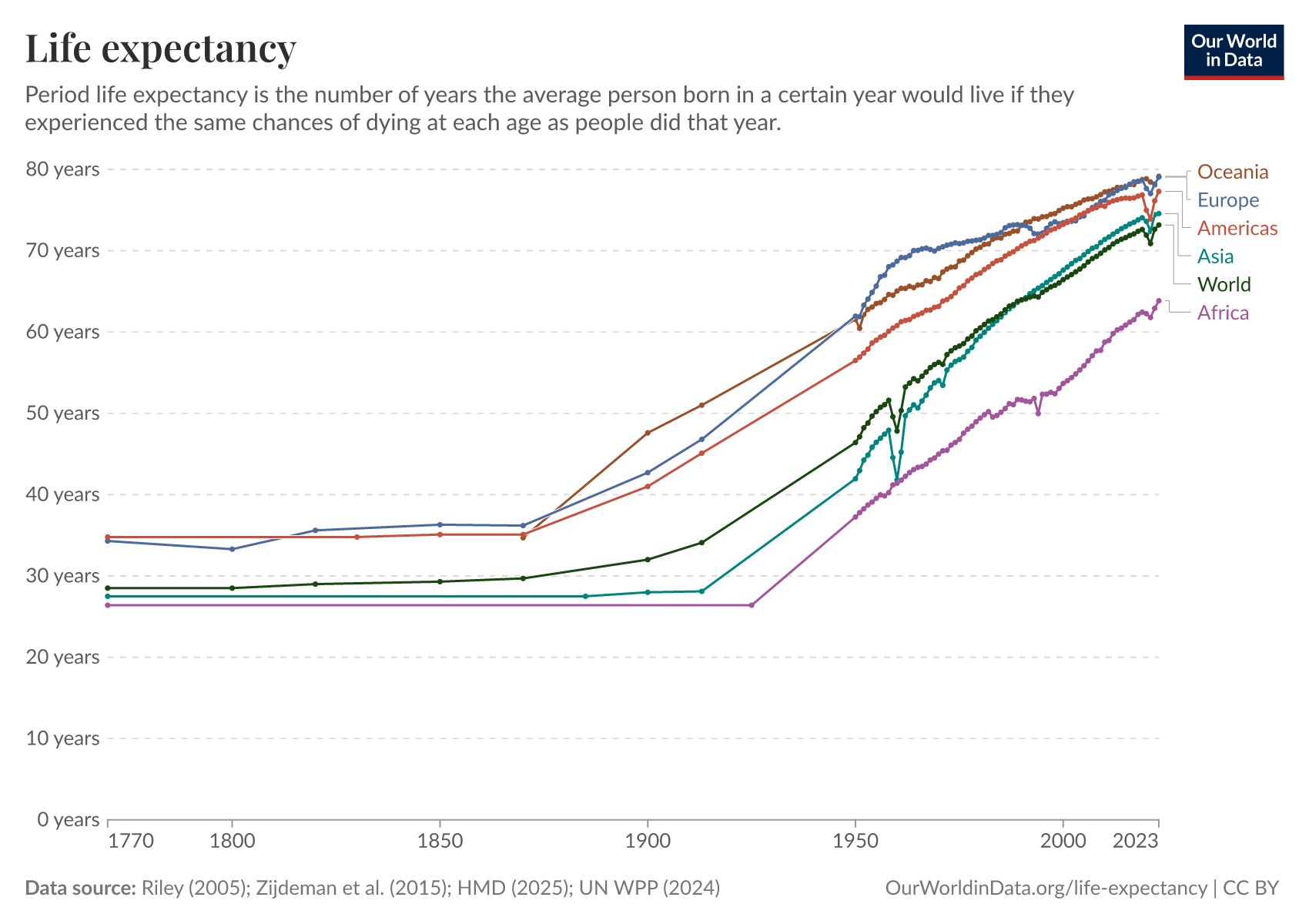
Life expectancyLong-run estimates collated from multiple sources by Our World in Data

CO₂ emissions per capitaLong-run estimates from the Global Carbon Budget

GDP per capitaLong-run estimates from the Maddison Project Database

Share of people who are undernourishedUN FAO

Literacy rateLong-run estimates collated from multiple sources by Our World in Data

Share of the population with access to electricityWorld Bank

Data explorers

See all our Data Explorers

Interactive visualization tools to explore a wide range of related indicators.

All our topics

All our data, research, and writing — topic by topic.

Population and Demographic Change

Health

Energy and Environment

Food and Agriculture

Poverty and Economic Development

Education and Knowledge

Innovation and Technological Change

Living Conditions, Community and Wellbeing

Human Rights and Democracy

Violence and War