Gdoc/Admin

Popular pages

Research and data to make progress against the world’s largest problems.

Read about our mission

Data Insights

Bite-sized insights on how the world is changing, published every few days.

See all Data Insights
Industrial robots in operation per 1,000 employees in manufacturing in 2023.

Horizontal bar chart listing 17 countries with the number of industrial robots in operation per 1,000 manufacturing employees. Key insight: South Korea leads with 101 robots per 1,000 employees, followed by Singapore with 77 and China with 47. Full country values, in descending order: South Korea 101; Singapore 77; China 47; Germany 43; Japan 42; Sweden 35; Slovenia 31; Denmark 31; Switzerland 30; United States 30; Netherlands 26; Austria 25; Italy 23; Canada 23; Slovakia 20; France 19; Spain 17.

Data source: International Federation of Robotics. License: CC BY.

Note: Industrial robots are automated, reprogrammable machines that can move in three or more directions and perform tasks in industrial settings. Examples of machines that are not classified as robots include software (for example, voice assistants), remote-controlled drones, self-driving cars, and “smart” washing machines.

South Korea uses more industrial robots per worker than any other country

This chart shows one way to compare automated manufacturing across countries — it plots the number of robots per 1,000 manufacturing employees.

The chart shows very large differences between countries. South Korea stands out, with more than one robot for every ten manufacturing workers.

Singapore comes second, and China ranks third, close to Germany. The United States sits in the middle, close to the European average, below Switzerland, Denmark and Slovenia.

This perspective shows industrial robot adoption in relative terms. In another Data Insight, I looked at robot adoption in absolute terms. From that perspective, China stands out by a large margin: it’s a large economy with a huge manufacturing sector, and it has by far the largest stock of industrial robots. Much of this expansion has happened recently: China’s annual installations increased 12-fold over a decade, helping it catch up to South Korea in terms of robots per worker.

Explore the interactive version of this chart
Continue reading
Three out of four people worldwide report being religious, but rates vary a lot across countries.
Horizontal bar chart of the share who say they are affiliated with any religion, based on self-identification regardless of practices or beliefs. Values shown: India 100%, Pakistan 100%, South Africa 97%, Global share 76% (annotated "Three-quarters of the world population are religious"), United States 70%, Australia 58%, South Korea 52%, Japan 43%, Hong Kong 29%, Czechia 27%, China 10% (annotated "Just one-in-ten people in China identify with a particular religion"). Data source: Pew Research Centre (2025).

Three out of four people worldwide consider themselves religious, but rates vary a lot across countries

Most people in the world are religious. When asked whether they identify with any religion, three-quarters of respondents choose one.

But in the chart, you can see huge differences in rates of religious affiliation across the world. In some countries, such as India and Pakistan, it’s almost universal: almost everyone identifies with a religion.

The opposite is true in China, where just one in ten people does. Several countries in East Asia, in particular, have particularly low rates of religious identification compared to other regions.

This doesn’t necessarily mean these populations hold no religious beliefs; they may still engage in activities that can be considered religious or spiritual, even though they don't describe themselves as belonging to any one in particular.

We show here just a small selection of countries; you can explore data for many more in our new topic page on religion.
Continue reading
Global plastic trade has fallen dramatically, mostly due to China’s ban on imports

Line chart, 1992 to 2021, showing tonnes of plastic imports on the vertical axis from 0 to 16 million t. Two series are plotted: total plastics imported across all countries and China’s imports. Key insight: total global imports rise from near zero in the 1990s to a peak around 2015 to 2016 of about 16 million tonnes, then collapse steeply to roughly 4 million tonnes by 2021 — a fall of more than two-thirds. China’s imports climb to about 8 million tonnes in the mid 2010s, then drop sharply to near zero after policy changes and stop completely in 2021. Annotations note China reduced plastic imports in 2016 and banned imports of plastic waste in 2018 with a complete end to imports in 2021. Data source: United Nations Comtrade Database (2025).

The global trade of plastic waste has fallen dramatically in the last decade

It might seem odd that countries would agree to import plastic waste from other countries, but many do so for the cheap materials or to feed specific manufacturing processes.

Environmentally, the trade in plastics has often been a concern, as it allows rich countries to effectively “dump” waste on poorer countries with weaker waste management systems.

The good news is that trade in plastic waste has fallen by more than two-thirds over the last decade. You can see this reduction in the chart.

China has been the biggest driver of this. It was once a large importer, but after a steep decline in trade in 2016 and a ban in 2018, many countries lost their largest export market.

In 2024, around 5 million tonnes of plastic waste were traded worldwide. For context, that is around 1% of the total plastic waste generated. What’s perhaps surprising is that most trade is now between high-income countries, which reduces the risk that this waste leaks into the environment.

Learn more in our updated topic page on plastic pollution.
Continue reading
Annual industrial robots installed. Line chart showing annual installations for China, Japan, United States, South Korea, and Germany from 2011 to 2023. China starts near 23,000 in 2011, rises to about 57,000 by 2014, reaches roughly 150,000 by 2017 to 2018, then climbs sharply to about 260,000 in 2021 and peaks near 290,000 in 2022 before a small decline to around 275,000 in 2023, far above the other countries. Japan, the United States, South Korea, and Germany stay in the roughly 10,000 to 60,000 range across the period, with modest peaks around 2018. The y-axis spans 0 to 300,000. The data source is: International Federation of Robotics (IFR) via AI Index Report (2025). A note reads: Software (e.g., voice assistants), remote-controlled drones, self-driving cars, or devices such as “smart” washing machines are not classified as robots.

China’s adoption of industrial robots has surged over the past decade

Industrial robots are rapidly becoming a common part of manufacturing in some countries. The chart here shows how many new ones are installed each year in the industrialized countries for which we have available data from the International Federation of Robotics (IFR).

In this dataset, industrial robots are defined as automatically controlled, reprogrammable, and multipurpose machines used in industrial settings. The data covers only physical industrial robots, not software or consumer technologies.

The chart shows that in 2011, China, the United States, Japan, Germany, and South Korea were all installing similar numbers of these robots. However, in the decade that followed, the paths of these countries diverged. By 2023, annual installations in China had risen to 276,000 robots, a twelvefold increase.

Over the same period, installations in the United States, Japan, Germany, and South Korea also increased, but much more slowly: none of them even doubled. The United States, which saw the second-largest rise, went from 21,000 new installations in 2011 to 38,000 in 2023.

These figures refer to new robots installed each year; that is, annual additions to the existing stock of robots. The IFR also publishes data on the total number of robots in operation, and by this measure, China also had the largest installed base, at around 1.76 million robots in 2023.

Relative to its large manufacturing sector, China’s stock of robots today does not stand out – but the data here shows that this is changing quickly.

Explore the interactive version of this chart.
Continue reading
Chart titled "the many costs of the Syrian civil war". It consists of eight small line charts of deaths due to fighting, all deaths, deaths of children under 5, internally displaced people, international refugees, GDP per capita, the share in extreme poverty, and the share undernourished between 2004 and 2024. It shows that the civil war didn't just kill hundreds of thousands due to fighting, but also increased deaths overall (especially those of young children), displaced millions, halved average living standards, and created extreme poverty and widespread undernourishment. Data sources include UCDP, the UN, Eurostat, OECD, IMF, World Bank, and FAO. The chart is licensed CC BY to Our World in Data.

The Syrian civil war has killed hundreds of thousands, displaced millions, and caused poor health and widespread poverty

Most of our work on war and peace focuses on the people killed directly in the fighting. But war has many other costs: it worsens people’s health, leaves them without work, and pushes them out of their homes.

The chart shows this for the civil war in Syria. Since the war began in 2011, more than 400,000 people have been killed in the fighting. At the same time, annual deaths increased as more people died from other causes. Young children were especially affected: estimates suggest that the number of annual child deaths more than doubled.

The war has also forced millions of people to leave their homes: in total, more than seven million are displaced within Syria, and almost as many are refugees elsewhere.

It also became much harder for people to make a living. Average living standards, measured by GDP per capita, have more than halved since the war began. As a result, poverty and hunger have risen sharply.

These numbers come with uncertainty because conflict makes it hard and dangerous to collect data.

This shows that to understand the costs of war, we need to have a broad perspective and see its impacts on health, displacement, and living standards.

Millions have died in conflicts since the Cold War; learn more about where and how.
Continue reading
What is the most common religious affiliation in each country?

Choropleth world map showing the most common religion reported by people in each country. Key pattern: Christians are the dominant group across the Americas, much of Europe, large parts of sub‑Saharan Africa, Australia and many Pacific nations. Muslims are most common across North Africa, the Middle East and many countries in West, Central and parts of South Asia. Hindus are most common in India (and Nepal). Buddhists are most common in several East and Southeast Asian countries. The religiously unaffiliated are the largest group in China and some other East Asian countries. Jews are the largest group only in Israel. A small number of countries are categorized as Other.

Data source: Pew Research Centre (2025). Data refer to the year 2020. Note: Based on how people describe their own religious identity, regardless of their practices or beliefs.

What is the most common religious affiliation in each country?

Three-quarters of people worldwide say they are religious. But rates of religious identity can vary a lot across countries, and so do the particular religions people follow.

In the map, you can see the most common religious affiliation for each country. This can include the “unaffiliated” who do not identify with any specific religion. This data is sourced from the Pew Research Center and is based on how people describe their own identity, regardless of their particular practices or beliefs.

As you can see, Christianity is the most common across much of Europe, the Americas, and Sub-Saharan Africa. Islam is the most common across North Africa and the Middle East, while Hinduism and Buddhism dominate across much of South Asia.

In East Asian countries such as China, Japan, and South Korea, the religiously unaffiliated are the biggest group. That doesn’t mean these populations hold no religious beliefs; they may still engage in activities that can be considered religious or spiritual, but they don’t describe themselves as belonging to any one in particular.

Explore the full breakdown of religious affiliations within each country, beyond just the most common answer.
Continue reading
Smallpox: when was it eliminated in each country? World choropleth map showing, for each country, the decade when smallpox was eliminated. Legend categories shown are: Before 1900; 1900s; 1910s; 1920s; 1930s; 1940s; 1950s; 1960s; 1970s. Subheading notes that smallpox was declared globally eradicated in 1980. Key pattern: most countries in Europe, North America, and Australia eliminated smallpox earlier in the 20th century, while many countries in Africa, South Asia, and parts of South America eliminated it later, concentrated in the 1960s to 1970s. Data source: Fenner et al. (1988).

William Foege, the physician who saved many millions from smallpox

William Foege, who sadly died this week, is one of the reasons why this map ends in the 1970s.

The physician and epidemiologist is best known for his pivotal role in the global strategy to eradicate smallpox, a horrific disease estimated to have killed 300 million people.

Despite the world having an effective vaccine for more than a century, smallpox was still widespread across many parts of Africa and Asia in the mid-20th century.

Foege played a crucial role in developing the “ring vaccination strategy”, which focused on vaccinating people around each identified case, rather than attempting a population-wide vaccination strategy, which was difficult in countries with limited resources.

This strategy, combined with increased global funding efforts and support for local health programs, paved the way: country after country declared itself free of smallpox. You can see this drop-off through the decades in the map.

The disease was declared globally eradicated in 1980.

William Foege and his colleagues’ contributions are credited with saving millions, if not tens of millions of lives.

Read more about the history of smallpox.
Continue reading

Explore our data

Featured data from our collection of 13,908 interactive charts.

See all our data

What share of children die before their fifth birthday?

What could be more tragic than the death of a young child? Child mortality, the death of children under the age of five, is still extremely common in our world today.

The historical data makes clear that it doesn’t have to be this way: it is possible for societies to protect their children and reduce child mortality to very low rates. For child mortality to reach low levels, many things have to go right at the same time: good healthcare, good nutrition, clean water and sanitation, maternal health, and high living standards. We can, therefore, think of child mortality as a proxy indicator of a country’s living conditions.

The chart shows our long-run data on child mortality, which allows you to see how child mortality has changed in countries around the world.

Explore the data
Explore the data

Share of population living in extreme povertyWorld Bank

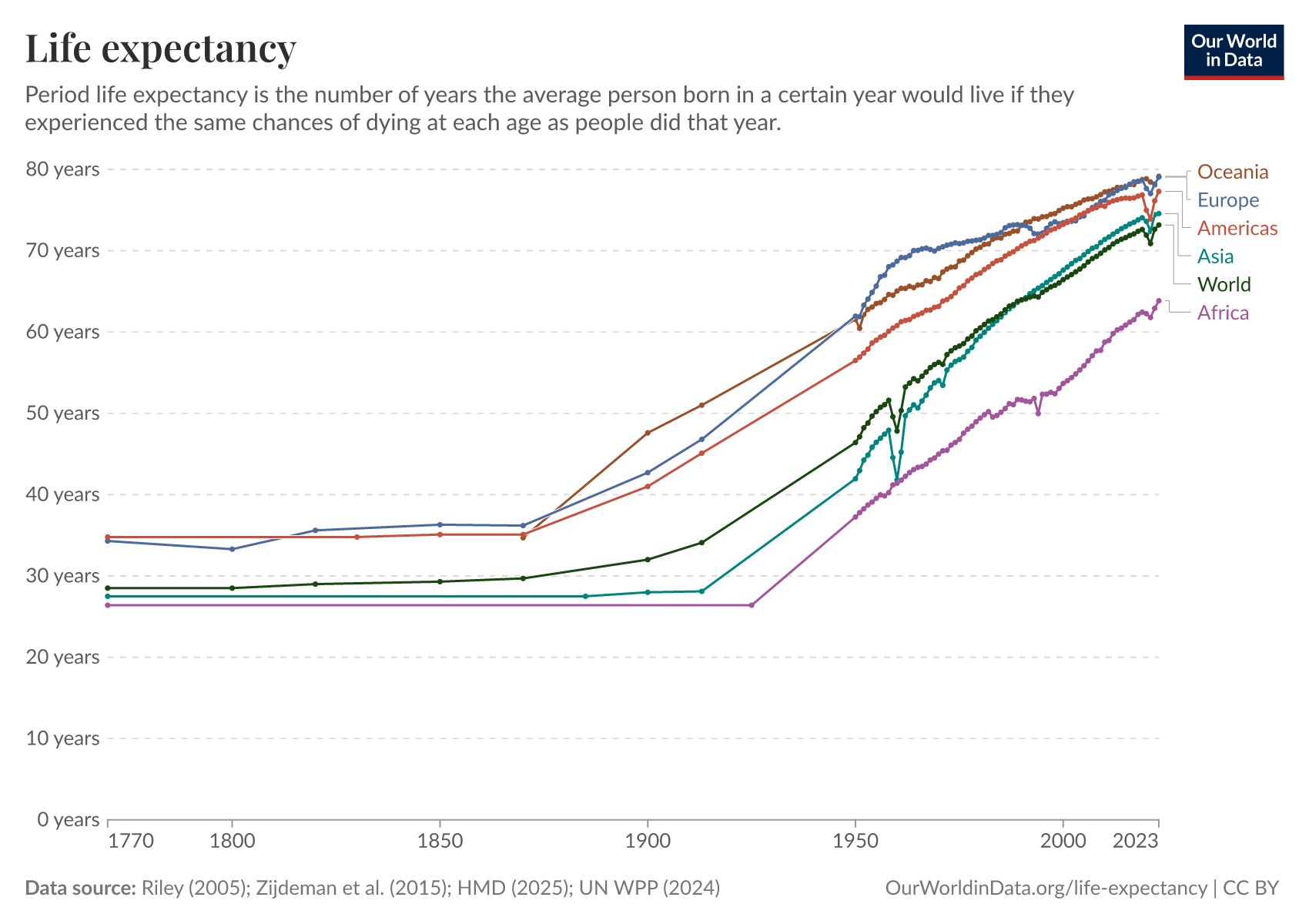
Life expectancyLong-run estimates collated from multiple sources by Our World in Data

CO₂ emissions per capitaLong-run estimates from the Global Carbon Budget

GDP per capitaLong-run estimates from the Maddison Project Database

Share of people who are undernourishedUN FAO

Literacy rateLong-run estimates collated from multiple sources by Our World in Data

Share of the population with access to electricityWorld Bank

Data explorers

See all our Data Explorers

Interactive visualization tools to explore a wide range of related indicators.

All our topics

All our data, research, and writing — topic by topic.

Population and Demographic Change

Health

Energy and Environment

Food and Agriculture

Poverty and Economic Development

Education and Knowledge

Innovation and Technological Change

Living Conditions, Community and Wellbeing

Human Rights and Democracy

Violence and War