Gdoc/Admin

Popular pages

Research and data to make progress against the world’s largest problems.

Read about our mission

We are a non-profit — all our work is free to use and open source.

Donate to support us

Data Insights

Bite-sized insights on how the world is changing, published every few days.

See all Data Insights
Global cancer deaths have increased, but age-adjusted rates have fallen. Line chart from 1980 to 2021 showing three series: estimated number of cancer deaths, crude cancer death rate, and age-standardized cancer death rate. Key findings annotated on the chart: the total number of cancer deaths has roughly doubled since 1980; crude cancer death rates have increased by just under 20 percent; age-adjusted cancer death rates have fallen by more than 20 percent. Data source: IHME, Global Burden of Disease (2024).

Global deaths from cancer have increased, but the world has made progress against it

Over the past four decades, the global number of people dying from cancer each year has doubled. This can look like the world is losing its battle with cancer: people are more likely to develop it, and we’re getting no better at treating it. This isn’t true.

There are, of course, almost 4 billion more people in the world than in 1980. And many of those people are older. This matters a lot because cancer rates rise steeply with age.

The chart shows three different measures. Total deaths just count how many people died from cancer; this is the number that has doubled. Crude death rates, shown in yellow, adjust for population size; the increase shrinks from more than 100% to around 20%. Age-adjusted rates, shown in blue, also account for the fact that countries have older populations today; we can see that the fully age-adjusted rate has actually fallen by more than 20%.

It means that for the average person, the likelihood of dying from cancer in any given year is now lower than it was for someone of a similar age in the past. The world still has a long way to go in preventing and treating cancer, but it’s wrong to think that no progress has been made.

Explore more insights and see how trends are evolving for different types of cancers.
Continue reading
Map titled “Population change in Europe: positive vs. negative growth.” Choropleth of Europe showing the difference in population on 1 July 2023 versus one year earlier. Countries are filled in one of two colors: pale peach (legend label: “Positive”) or orange (legend label: “Negative”). On the map most Western and some Northern European countries are pale peach; Russia, much of Central and Eastern Europe and parts of the Balkans are orange. Legend and the two-category color scale appear at the bottom.

Some parts of Europe have a growing population, while others are shrinking

The map shows which European countries saw an increase in population, and which saw a decrease in the year from July 2022 to 2023.

The regional divide is stark: most countries with negative population change are located in the eastern and southern parts of Europe, while countries in the west and north saw population growth.

We focus on 2022–2023 as they are the most recent years in the UN’s latest World Population Prospects, published in 2024. Temporary shocks can influence year-to-year population changes, but this regional pattern is not unique to this particular year: you see it in earlier years too, and it also shows up when you look at population change over longer periods.

A key driver of this is migration. Most countries in Western and Northern Europe have had positive net migration (i.e., more people arriving than leaving). Many countries in Eastern and Southern Europe, in contrast, have had more people leaving than arriving.

Fertility rates have been declining across Europe, and all of these countries now have rates below the replacement level. That means that across much of Europe, since deaths now exceed births, the population would be shrinking without migration. In Western and Northern Europe, positive net migration has been offsetting this.

Explore country-by-country trends in our Population & Demography Explorer.
Continue reading
Child deaths outnumber homicide deaths in the United States.

Two-column bar chart comparing annual deaths (data for 2023). Left column: "Child deaths (under-15s, all causes)" — 30,200 deaths. Right column: "Homicides (all ages)" — 22,800 deaths. Subtitle notes that everyday tragedies of children dying from preterm birth, sepsis, and asphyxia receive far less media and public attention. Note: numbers rounded; approximately 1,000 child deaths were by homicide and are included in both columns. Data sources: UN IGME for child deaths; US CDC for homicides.

Child deaths outnumber homicides in the United States, but get far less public attention

It’s a widespread view that child deaths are still a pressing problem in poorer countries, but not in rich ones.

I don’t think this is true, and I want to illustrate it with one example from the United States.

In 2023, 30,200 children died in the US. In the same year, 22,800 Americans of any age were killed through homicide. You can see this in the chart.

Few Americans would argue that murders are a “solved problem”. And this is certainly not what you’d take away from the news. As we showed in a recent article, homicides receive disproportionate coverage in both left- and right-leaning media, relative to the number of people who die from them.

The everyday tragedies of children dying from preterm births, neonatal sepsis, and asphyxia do not get nearly the same attention, but are no less important. These are problems that we can still make more progress on.

I’ve recently written about what high-income countries can do to continue reducing child deaths.
Continue reading
The image presents a series of line graphs comparing the growth of food supplies and population from 1961 to 2022 across different continents and globally. 

In the "Worldwide" section, the graph shows a green line representing food supplies, which has increased 3.5 times, and a red line indicating population growth, which has increased 2.6 times. It notes that the world’s population grew from 3 billion to over 8 billion.

In Africa, the food supply growth is represented by a green line that increased 6.2 times, compared to a 2.6 times increase in population. The Asia panel shows a 4.4 times increase in food supplies against a 2.7 times rise in population.

For Europe, a note indicates that following the collapse of the Soviet Union, food production declined, but the growth of food supplies is still shown as positive. In South America, food supplies increased 3.8 times, with a 2.9 times population growth. 

Central and North America show a food supply increase of 2.9 times and a population rise of 2.1 times, while Oceania has a 2.8 times increase in food supplies against a 2.5 times increase in population.

In the footer, data sources are credited to the Food and Agriculture Organization of the United Nations for 2024. The image is licensed under Creative Commons by Pablo Rosado and Max Roser.

On every continent, food supplies have grown faster than the population

We just lived through the period with the fastest population growth in human history. Six decades ago, there were three billion people on our planet. Since 2022, there have been more than eight billion people — an increase of five billion over this period.

It would have been impressive if food supplies had merely kept pace with population growth. But as the chart above shows, they grew even faster. On every continent, food supplies — measured by calories — grew faster than the population. This rise in food production per person was a major reason for the decline of extreme poverty and hunger.

To us, this chart documents one of humanity’s most extraordinary achievements.

Hunger remains a large problem today, especially in Africa. We recommend the article by our colleague Hannah Ritchie: “Increasing agricultural productivity across Sub-Saharan Africa is one of the most important problems this century”.

A note on the data: Food supply estimates come from the Food and Agriculture Organization of the United Nations. We adjusted them to account for changes in region definitions and data coverage over time.

Continue reading
South Korea has doubled its productivity since 2000, surpassing Japan.

Line chart showing productivity measured as GDP per hour of work from 2000 to 2023 for South Korea and Japan. Y axis labeled 0 dollars per hour to 60 dollars per hour; x axis shows years 2000 to 2023. South Korea’s line rises from a labeled point of $25 per hour in 2000 to a labeled point of $54 per hour in 2023, crossing and ending above Japan’s line. Japan’s line stays relatively flat, roughly in the range of about 45 to 52 dollars per hour with a small peak around 2010 and a slight decline afterward. Data source: Feenstra et al. - Penn World Table (2025). Note: This data is expressed in international‑$ at 2021 prices per hour, using multiple benchmark years to adjust for differences in living costs between countries over time. License: CC BY.

South Korea has doubled its productivity since 2000, overtaking Japan

The economist Paul Krugman once said, “Productivity isn’t everything, but in the long run, it’s almost everything”. When workers can produce more value in the same amount of time, economies can grow faster, and living standards can rise.

The chart shows the productivity metric published by the Penn World Table for South Korea and Japan. It measures gross domestic product (GDP) per hour of work.

Since 2000, South Korea’s productivity has more than doubled, narrowing what was once a vast gap with Japan. It has now even surpassed its neighbor.

Many forces affect productivity, but one stands out in Korea’s case: its commitment to innovation. The country spends nearly 5% of GDP on research and development, among the highest shares in the world, and it files far more patents per million people than any other nation.

Explore productivity growth for more countries in our newly updated data from the Penn World Table.
Continue reading
How does the UK government spend £100 of its budget?

Stacked vertical bar chart showing share of total government spending scaled to £100, data for 2023, the latest year available. Categories and amounts, listed top to bottom on the bar:
- Social protection £33 — pensions; benefits for sickness and disability; family and children; unemployment; housing benefits.
- Health £19 — hospitals; doctors; medical products; appliances and equipment; outpatient services; public health services.
- Public services £14 — public administration; financial and fiscal affairs; external affairs; foreign economic aid; debt interest.
- Education £10 — schools and universities.
- Economic affairs £10 — support for industries and transport infrastructure.
- Defense £5 — military and civil defense; military aid.
- Other £9 — police and safety; public housing development; water supply; culture; environmental protection.

Note: Includes central and local governments, and social security funds. Data source: OECD (2025). CC BY.

How the UK government spends £100 of its budget

What does the British government spend its budget on? The chart shows spending broken down by category, scaled to £100. It combines both central and local government spending.

Social protection is the single largest item. Out of every £100 spent, £33 goes to it — more than health, at £19 per £100. The UK is typical in this regard — in every OECD country except the US, social protection is the biggest category.

Public services also account for a large share: £14 per £100. These include core government functions, foreign aid, and interest payments on government debt.

Education and economic affairs, which support the broader economy or specific industries such as fishing and manufacturing, are also prominent categories.

Explore how other OECD countries spend their budgets.
Continue reading
The Baltic states all doubled their GDP per capita since 2000. Line chart showing GDP per capita for Estonia, Lithuania, and Latvia with data points at 2000 and 2024. In 2000: Estonia $21k, Lithuania $16k, Latvia $15k. In 2024: Lithuania $47k, Estonia $42k, Latvia $39k. Each country’s two points are connected by a line showing roughly a doubling from 2000 to 2024. Data source: Eurostat, OECD, IMF, and World Bank (2025). Note: this data is expressed in international dollars at 2021 prices. License: CC BY.

GDP per capita has doubled in all three Baltic states since 2000

Since 2000, GDP per capita has doubled in all three Baltic states: Estonia, Latvia, and Lithuania (where it has nearly tripled).

Living conditions in these countries have improved more broadly. Poverty rates are lower, and life satisfaction is higher. Incomes have not just doubled in terms of GDP per capita; median incomes have also doubled.

Read more from my colleague Max Roser about economic growth, how it’s measured, and why it matters.
Continue reading

Explore our data

Featured data from our collection of 13,916 interactive charts.

See all our data

What share of children die before their fifth birthday?

What could be more tragic than the death of a young child? Child mortality, the death of children under the age of five, is still extremely common in our world today.

The historical data makes clear that it doesn’t have to be this way: it is possible for societies to protect their children and reduce child mortality to very low rates. For child mortality to reach low levels, many things have to go right at the same time: good healthcare, good nutrition, clean water and sanitation, maternal health, and high living standards. We can, therefore, think of child mortality as a proxy indicator of a country’s living conditions.

The chart shows our long-run data on child mortality, which allows you to see how child mortality has changed in countries around the world.

Explore the data
Explore the data

Share of population living in extreme povertyWorld Bank

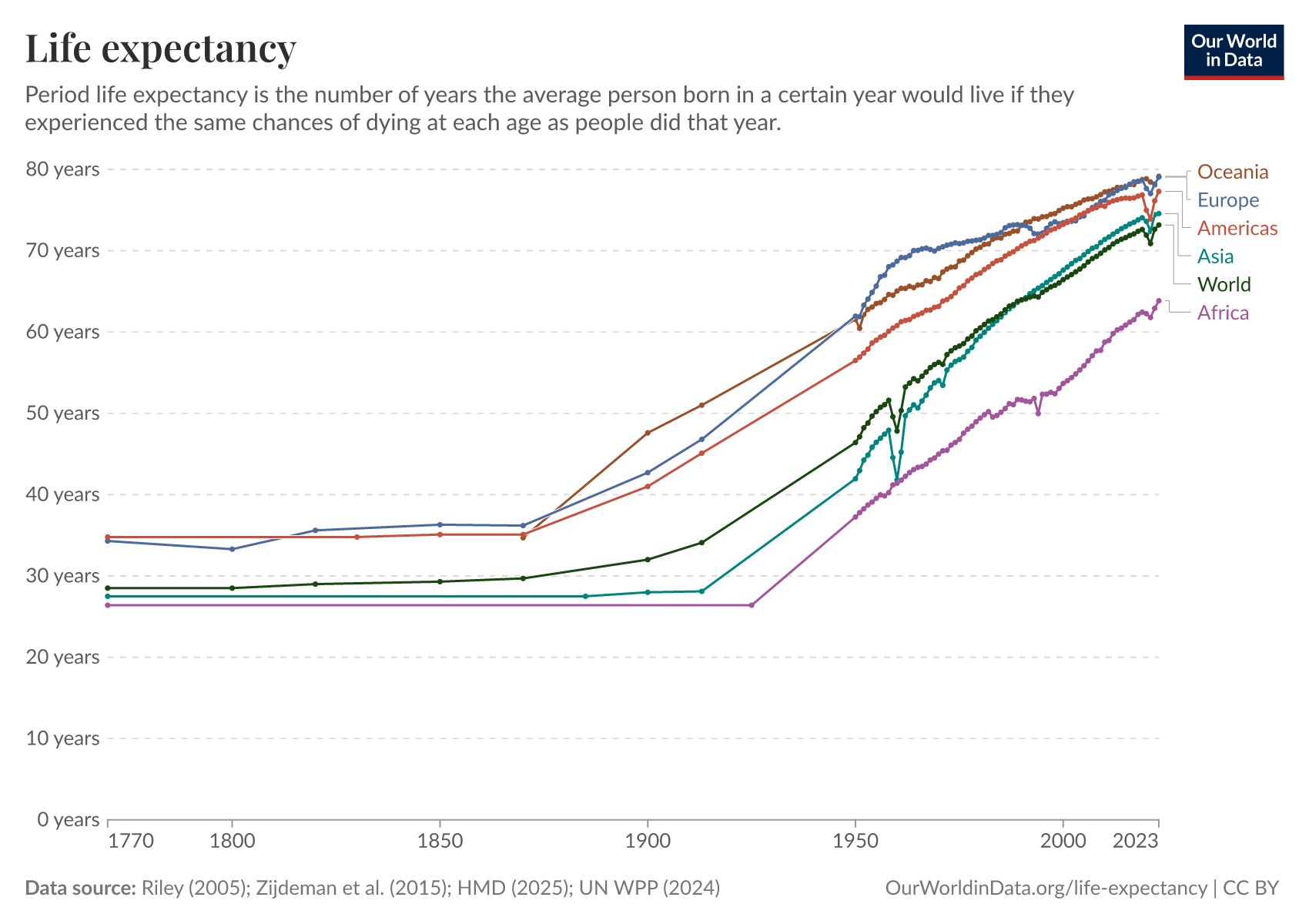
Life expectancyLong-run estimates collated from multiple sources by Our World in Data

CO₂ emissions per capitaLong-run estimates from the Global Carbon Budget

GDP per capitaLong-run estimates from the Maddison Project Database

Share of people who are undernourishedUN FAO

Literacy rateLong-run estimates collated from multiple sources by Our World in Data

Share of the population with access to electricityWorld Bank

Data explorers

See all our Data Explorers

Interactive visualization tools to explore a wide range of related indicators.

All our topics

All our data, research, and writing — topic by topic.

Population and Demographic Change

Health

Energy and Environment

Food and Agriculture

Poverty and Economic Development

Education and Knowledge

Innovation and Technological Change

Living Conditions, Community and Wellbeing

Human Rights and Democracy

Violence and War