


 Hong Kong Country Profile
Health
Improving people's health in the future starts with understanding people’s health today. What are people dying from? Are children surviving their first years? How does life expectancy compare with other countries? This page tracks key health metrics for Hong Kong.
The data is updated regularly with the latest global and country estimates. Sometimes the latest data is two or three years behind the current year.
Child health
What do children die from in Hong Kong?
To stop children from dying, we need to know what they are dying from. Understanding this allows governments and society to develop and focus on the largest causes of death. That can lead to a stronger focus on the interventions that would make the biggest difference.
In the treemap below, you can see estimates for Hong Kong. The total size of the visualization represents the total number of under-fives that died. Each box inside is a cause of death, with its size proportional to the share of child deaths.
Maternal health
What is Hong Kong’s maternal mortality rate?
Maternal deaths are those that occur during a woman’s pregnancy, at childbirth, or in the following six weeks.
This is not only tragic for the woman herself, but for the children and family she leaves behind.
In the chart, you can see Hong Kong’s maternal mortality rates over time, alongside neighboring countries for comparison. This is measured as the number of deaths per 100,000 live births.
In 2017, 1.35 women died per 100,000 live births.

What share of births in Hong Kong are attended by skilled workers?
Having skilled health staff available at childbirth can improve health outcomes for both the mother and baby, especially if complications arise.
In the chart, you see the share of births attended by skilled workers in Hong Kong, alongside its neighbors. In 2005, this share was 100%.

Life expectancy
What is Hong Kong’s life expectancy at birth?
In 2023, Hong Kong’s life expectancy at birth was 85.5 years.
You can see how this has changed over time in the chart, alongside neighboring countries.
This is a period measure of life expectancy, which tells us the average number of years a newborn would live if today’s death rates at each age remained constant throughout their life. This does not necessarily reflect the most common age of death in the country.

What is the life expectancy of men and women in Hong Kong?
In most countries, women live on average longer than men. But the size of this life expectancy gap varies.
In the chart, you can see life expectancy at birth for men and women in Hong Kong.
In 2023, life expectancy was 88.1 years for women, and 82.8 years for men.

What is Hong Kong’s life expectancy at different ages?
Life expectancy at birth is often sensitive to death rates at younger ages. In particular, life expectancy is low when child mortality rates are high. These figures would tell you very little about how long a 40, 50, or 60-year-old could expect to live.
It’s therefore useful to look at life expectancy at different ages. This is shown in the chart for 10, 25, 45, 65, and 80-year-olds.

Causes of death
How are death rates from infectious diseases in Hong Kong changing?
Infectious diseases include a broad range of illnesses that can be spread through vectors, such as contaminated water or mosquitoes, or from person to person. This includes diseases such as malaria, HIV/AIDS, tuberculosis, pneumonia, influenza, and COVID-19.
In the chart, you can see how death rates from communicable diseases in Hong Kong have changed over time. This is shown alongside neighboring countries for comparison.

Are deaths from cardiovascular disease in Hong Kong increasing or decreasing?
One of the leading causes of death in many countries is cardiovascular disease. These deaths are far more likely in older people, so as countries make progress on reducing deaths at younger ages, it’s likely to become a more dominant cause of death.
Is Hong Kong making progress against cardiovascular disease?
There are several metrics we can use to understand mortality: the total number of deaths, the crude death rate (which simply divides the number of deaths by the country’s population), or the age-standardized death rate, which holds the age structure of the population constant, removing the effect of population aging from the trend.
In the chart below, you can see the change in these three metrics for Hong Kong.

Are deaths from cancer in Hong Kong increasing or decreasing?
Another leading cause of death in many countries is cancer.
Is Hong Kong making progress on reducing cancer deaths?
Again, we can use the same indicators to understand mortality: the total number of deaths, the crude death rate (which simply divides the number of deaths by the country’s population), or the age-standardized death rate, which holds the age structure of the population constant, so it tells us about how rates are changing regardless of aging. This is important because the risk of most cancers also increases steeply with age.
In the chart below, you can see the change in these three metrics for Hong Kong.

Risk factors
What are the largest health risk factors in Hong Kong?
Many environmental, societal, and lifestyle factors increase the risk of someone developing a disease or other health problem. These are called “risk factors” and include things such as smoking, air pollution, obesity, insufficient physical activity, and diet.
In the chart, you can see modeled estimates for how many people in Hong Kong die prematurely as a result of various risk factors. Note that the same death can be attributed to multiple risk factors, so the death tolls from different risk factors cannot simply be added up (this is why their sum can be higher than the total number of deaths).
Each figure estimates how many deaths would have been averted if that risk factor had not existed.


How much air pollution are people in Hong Kong exposed to?
Air pollution is a key risk factor for premature death and illness in many countries. This can come from either indoor or outdoor exposure to air pollutants.
The health risks of outdoor air pollution depend on how much people are exposed to it.
In the chart, you can see the average level of exposure to small suspended particles in Hong Kong, compared to the global and regional averages.

Vaccinations
What share of children in Hong Kong receive key vaccinations?
Many vaccinations are effective in protecting people against potentially fatal diseases. Most recommended vaccinations are administered during childhood, where they can give the most effective and prolonged protection. Childhood vaccinations are estimated to have saved the lives of around 150 million children globally over the last 50 years.
What share of children in Hong Kong get vaccinated? The chart below shows the data across a range of important vaccines.

Mental health
Mental health is a crucial part of people’s overall health.
Mental health conditions are not uncommon. Hundreds of millions suffer from them yearly, and many more do over their lifetimes. It’s estimated that 1 in 3 women and 1 in 5 men will experience major depression in their lives. Other conditions, such as schizophrenia and bipolar disorder, are less common but still have a large impact on people’s lives.
We think it’s important to present reliable data on the prevalence of mental health conditions, but unfortunately, good national estimates from across the world are not available.
This is a key data gap in our understanding of global health.
Healthcare spending
Global Health
An overview of our research on global health.
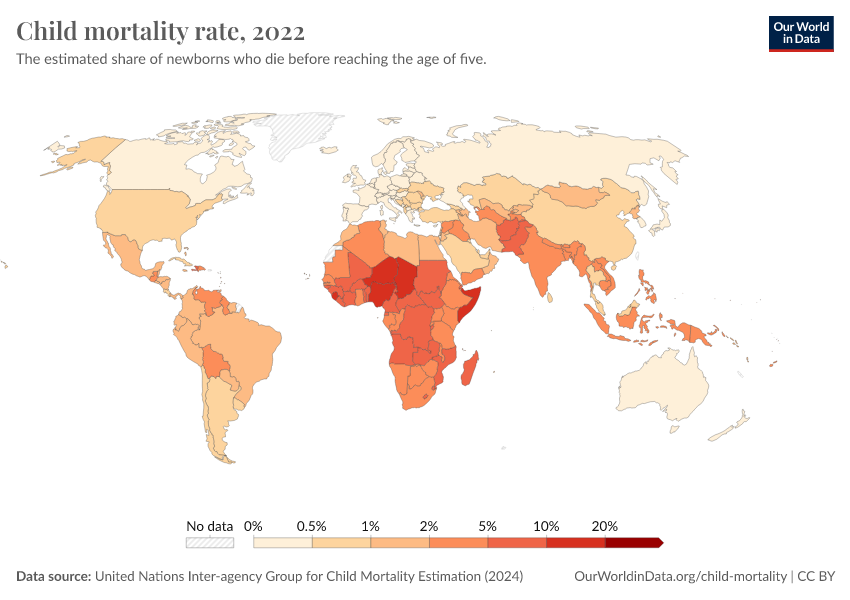
Global Health Data Explorer
Explore data on child and maternal health, diseases, life expectancy, and health systems around the world.
What do people die from in different countries?
Explore causes of death data for all countries, spanning more than four decades.
Cite this work
Our articles and data visualizations rely on work from many different people and organizations. When citing this profile page, please also cite the underlying data sources. This profile page can be cited as:
Hannah Ritchie (2026) - “Health” Published online at OurWorldinData.org. Retrieved from: 'https://ourworldindata.org/profile/health/hong-kong' [Online Resource]BibTeX citation
@article{owid-health-hong-kong,
    author = {Hannah Ritchie},
    title = {Health},
    journal = {Our World in Data},
    year = {2026},
    note = {https://ourworldindata.org/profile/health/hong-kong}
}
Reuse this work freely
All visualizations, data, and articles produced by Our World in Data are completely open access under the Creative Commons BY license. You have the permission to use, distribute, and reproduce these in any medium, provided the source and authors are credited.
The data produced by third parties and made available by Our World in Data is subject to the license terms from the original third-party authors. We will always indicate the original source of the data in our documentation, so you should always check the license of any such third-party data before use and redistribution.
All of our charts can be embedded in any site.