


What you should know about this indicator
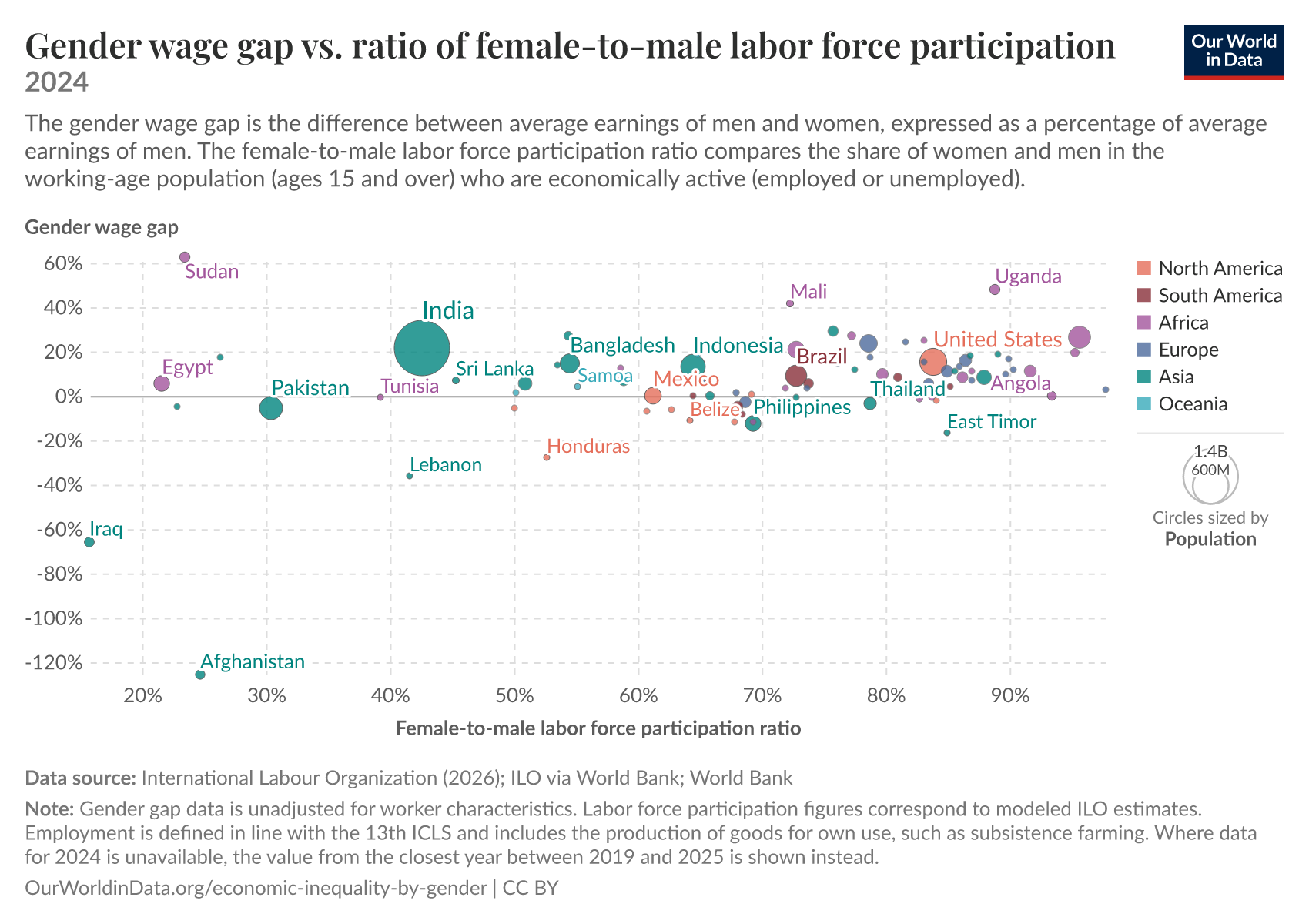
- This data measures the gender wage gap: the difference between the average hourly earnings of men and the average hourly earnings of women, expressed as a percentage of men’s average earnings. Positive values mean that men earn more than women on average; negative values mean that women earn more.
- This is an unadjusted gender wage gap. It compares the average earnings of men and women employees, without accounting for other differences, such as education, experience, and detailed occupation. This means the gap reflects not only differences in pay for similar work, but also differences in individual characteristics and the kinds of jobs men and women hold.
- This data covers paid employees only. It does not include self-employed workers, who make up a large share of the workforce in many countries.
- This data comes from the International Labour Organization’s ILOSTAT database, which compiles labor statistics from national sources. Underlying national surveys differ in design and coverage, so cross-country comparisons should be made with some caution.
Related research and writing
Explore charts that include this data



More Data on Work & Employment
Sources and processing
This data is based on the following sources
How we process data at Our World in Data
All data and visualizations on Our World in Data rely on data sourced from one or several original data providers. Preparing this original data involves several processing steps. Depending on the data, this can include standardizing country names and world region definitions, converting units, calculating derived indicators such as per capita measures, as well as adding or adapting metadata such as the name or the description given to an indicator.
At the link below you can find a detailed description of the structure of our data pipeline, including links to all the code used to prepare data across Our World in Data.
Notes on our processing step for this indicator
We removed data points flagged as "unreliable" by the source (i.e. obs_status = "U" in the original data). These data points are likely to be inaccurate and misleading for analysis.
Reuse this work
Citations
How to cite this page
To cite this page overall, including any descriptions, FAQs or explanations of the data authored by Our World in Data, please use the following citation:
“Data Page: Gender wage gap”, part of the following publication: Bertha Rohenkohl, Pablo Arriagada, and Esteban Ortiz-Ospina (2026) - “Work and Employment”. Data adapted from International Labour Organization. Retrieved from https://archive.ourworldindata.org/20260826-181749/grapher/gender-gap-in-average-wages-ilo.html [online resource] (archived on August 26, 2026).How to cite this data
In-line citationIf you have limited space (e.g. in data visualizations), you can use this abbreviated in-line citation:
International Labour Organization (2026) – with major processing by Our World in DataFull citation
International Labour Organization (2026) – with major processing by Our World in Data. “Gender wage gap – ILO” [dataset]. International Labour Organization, “ILOSTAT” [original data]. Retrieved September 20, 2026 from https://archive.ourworldindata.org/20260826-181749/grapher/gender-gap-in-average-wages-ilo.html (archived on August 26, 2026).Download
Quick download
Download the data shown in this chart as a ZIP file containing a CSV file, metadata in JSON format, and a README. The CSV file can be opened in Excel, Google Sheets, and other data analysis tools.
Data API
Use these URLs to programmatically access this chart's data and configure your requests with the options below. Our documentation provides more information on how to use the API, and you can find a few code examples below.
Data URL (CSV format)
https://ourworldindata.org/grapher/gender-gap-in-average-wages-ilo.csv?v=1&csvType=full&useColumnShortNames=falseMetadata URL (JSON format)
https://ourworldindata.org/grapher/gender-gap-in-average-wages-ilo.metadata.json?v=1&csvType=full&useColumnShortNames=falseExcel / Google Sheets
=IMPORTDATA("https://ourworldindata.org/grapher/gender-gap-in-average-wages-ilo.csv?v=1&csvType=full&useColumnShortNames=false")Python with Pandas
import pandas as pd
import requests

# Fetch the data.
df = pd.read_csv("https://ourworldindata.org/grapher/gender-gap-in-average-wages-ilo.csv?v=1&csvType=full&useColumnShortNames=false", storage_options = {'User-Agent': 'Our World In Data data fetch/1.0'})

# Fetch the metadata
metadata = requests.get("https://ourworldindata.org/grapher/gender-gap-in-average-wages-ilo.metadata.json?v=1&csvType=full&useColumnShortNames=false").json()
R
library(jsonlite)

# Fetch the data
df <- read.csv("https://ourworldindata.org/grapher/gender-gap-in-average-wages-ilo.csv?v=1&csvType=full&useColumnShortNames=false")

# Fetch the metadata
metadata <- fromJSON("https://ourworldindata.org/grapher/gender-gap-in-average-wages-ilo.metadata.json?v=1&csvType=full&useColumnShortNames=false")
Stata
import delimited "https://ourworldindata.org/grapher/gender-gap-in-average-wages-ilo.csv?v=1&csvType=full&useColumnShortNames=false", encoding("utf-8") clear