


What you should know about this indicator
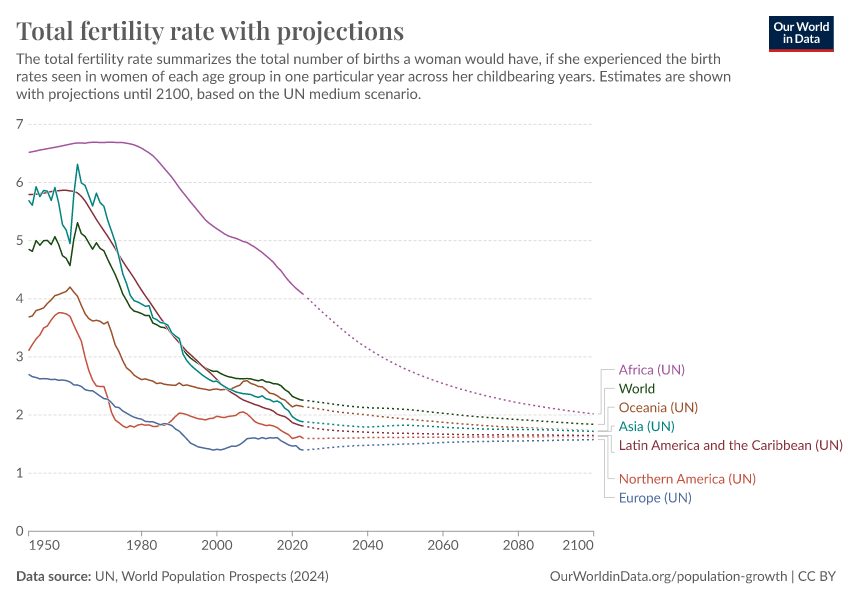
The UN's projections come in three scenarios: medium, high, and low. The medium scenario is the central estimate; the high and low scenarios are designed to fully reach 0.5 births per woman above and below the medium from the mid-2030s onward (e.g. medium 2.1 → high 2.6, low 1.6). In the first decade of the projection the gap is narrower (about ±0.25 in 2024–2028, ±0.4 in 2029–2033).
Related research and writing
Explore charts that include this data


Sources and processing
This data is based on the following sources
How we process data at Our World in Data
All data and visualizations on Our World in Data rely on data sourced from one or several original data providers. Preparing this original data involves several processing steps. Depending on the data, this can include standardizing country names and world region definitions, converting units, calculating derived indicators such as per capita measures, as well as adding or adapting metadata such as the name or the description given to an indicator.
At the link below you can find a detailed description of the structure of our data pipeline, including links to all the code used to prepare data across Our World in Data.
Notes on our processing step for this indicator
The UN doesn't publish a total fertility rate for our continental aggregates (Africa, Asia, Europe, North America, South America, Oceania), since its own regional groupings differ. We derive these by summing the age-specific fertility rates across the 5-year reproductive age groups (15–19 to 45–49) and multiplying by 5, where each age-specific rate uses regional totals for births and female population.
Reuse this work
Citations
How to cite this page
To cite this page overall, including any descriptions, FAQs or explanations of the data authored by Our World in Data, please use the following citation:
“Data Page: Fertility rate”. Our World in Data (2026). Data adapted from United Nations. Retrieved from https://archive.ourworldindata.org/20260910-003655/grapher/children-per-woman-un.html [online resource] (archived on September 10, 2026).How to cite this data
In-line citationIf you have limited space (e.g. in data visualizations), you can use this abbreviated in-line citation:
UN, World Population Prospects (2024) – processed by Our World in DataFull citation
UN, World Population Prospects (2024) – processed by Our World in Data. “Fertility rate – UN WPP” [dataset]. United Nations, “World Population Prospects”; United Nations, “World Population Prospects – Interim Update” [original data]. Retrieved September 28, 2026 from https://archive.ourworldindata.org/20260910-003655/grapher/children-per-woman-un.html (archived on September 10, 2026).Download
Quick download
Download the data shown in this chart as a ZIP file containing a CSV file, metadata in JSON format, and a README. The CSV file can be opened in Excel, Google Sheets, and other data analysis tools.
Data API
Use these URLs to programmatically access this chart's data and configure your requests with the options below. Our documentation provides more information on how to use the API, and you can find a few code examples below.
Data URL (CSV format)
https://ourworldindata.org/grapher/children-per-woman-un.csv?v=1&csvType=full&useColumnShortNames=falseMetadata URL (JSON format)
https://ourworldindata.org/grapher/children-per-woman-un.metadata.json?v=1&csvType=full&useColumnShortNames=falseExcel / Google Sheets
=IMPORTDATA("https://ourworldindata.org/grapher/children-per-woman-un.csv?v=1&csvType=full&useColumnShortNames=false")Python with Pandas
import pandas as pd
import requests

# Fetch the data.
df = pd.read_csv("https://ourworldindata.org/grapher/children-per-woman-un.csv?v=1&csvType=full&useColumnShortNames=false", storage_options = {'User-Agent': 'Our World In Data data fetch/1.0'})

# Fetch the metadata
metadata = requests.get("https://ourworldindata.org/grapher/children-per-woman-un.metadata.json?v=1&csvType=full&useColumnShortNames=false").json()
R
library(jsonlite)

# Fetch the data
df <- read.csv("https://ourworldindata.org/grapher/children-per-woman-un.csv?v=1&csvType=full&useColumnShortNames=false")

# Fetch the metadata
metadata <- fromJSON("https://ourworldindata.org/grapher/children-per-woman-un.metadata.json?v=1&csvType=full&useColumnShortNames=false")
Stata
import delimited "https://ourworldindata.org/grapher/children-per-woman-un.csv?v=1&csvType=full&useColumnShortNames=false", encoding("utf-8") clear