
Data

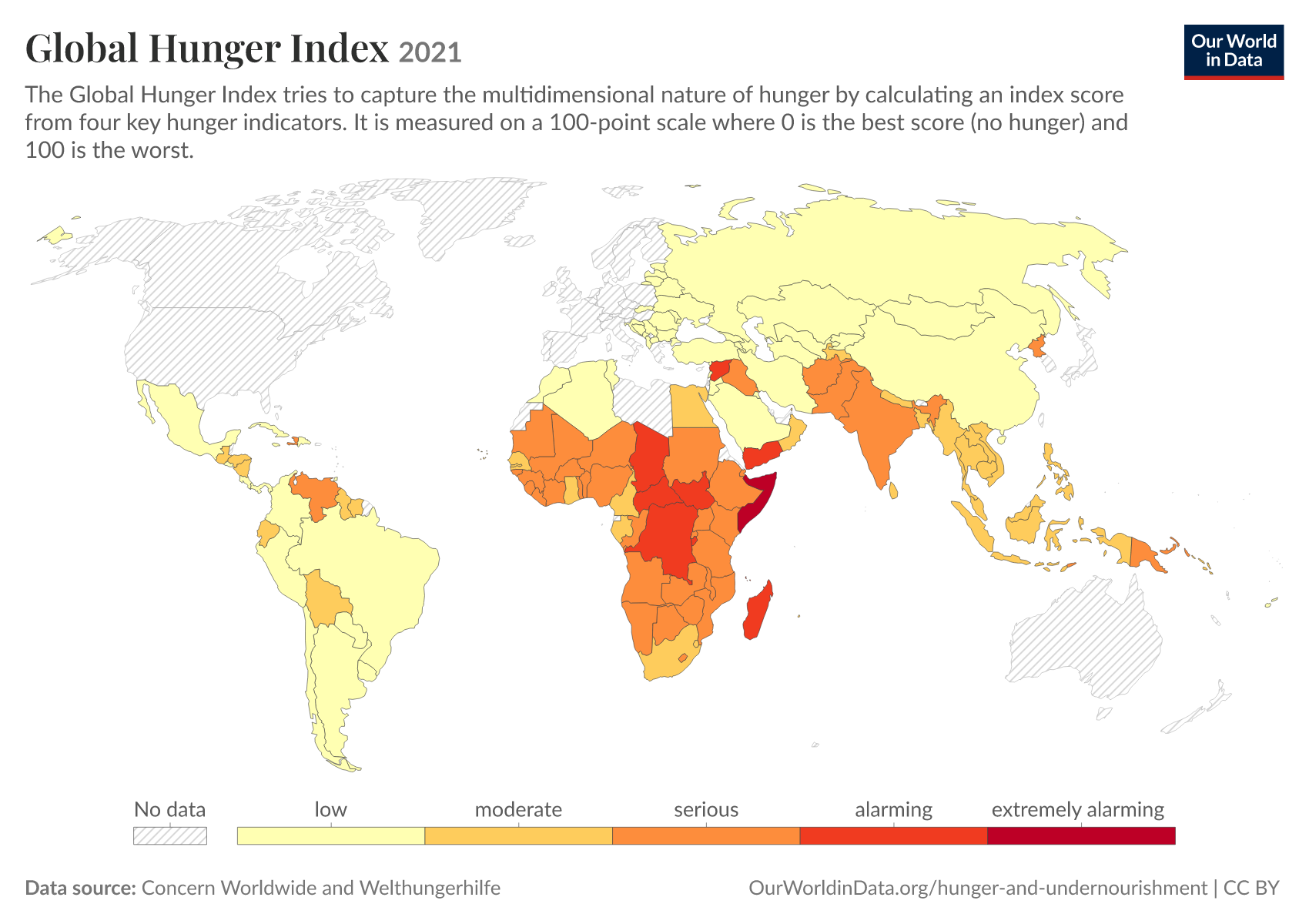
Global Hunger Index

About this data

Source
Concern Worldwide and Welthungerhilfe (2021)processed by Our World in Data
Last updated
February 24, 2022
Date range
2000–2021

Sources and processing

Concern Worldwide and Welthungerhilfe – Global Hunger Index

The Global Hunger Index (GHI) is a tool designed to comprehensively measure and track hunger globally, regionally, and by country. To reflect the multidimensional nature of hunger, the GHI combines four component indicators into one index score. An increase in a country's GHI score indicates that the hunger situation is worsening, while a decrease in the score indicates an improvement in the hunger situation.

The four indicators used to calculate the GHI are:

  • Undernourishment: the proportion of undernourished people as a percentage of the population;

  • Child wasting: the proportion of children under the age of five who suffer from wasting (low weight for their height, reflecting acute undernutrition);

  • Child stunting: the proportion of children under the age of five who suffer from stunting (low height for their age, reflecting chronic undernutrition); and

  • Child mortality: the mortality rate of children under the age of five (partially reflecting the fatal synergy of inadequate nutrition and unhealthy environments).

The formula and weighting of these four indicators in relation to the final index score can be found at: https://www.globalhungerindex.org/pdf/en/2021.pdf

The 2021 GHI has been calculated for 135 countries for which data on the four component indicators are available and where measuring hunger is considered most relevant. GHI scores are not calculated for some higher-income countries where the prevalence of hunger is very low.

Where original source data were unavailable, the GHI was estimated based on the most recent data available. For 19 countries, individual scores could not be calculated owing to lack of data. 12 of those countries (Burundi, Comoros, Guinea, Guinea-Bissau, Moldova, Niger, South Sudan, Syria, Tajikistan, Uganda, Zambia, and Zimbabwe) were provisionally designated by severity. In OWID's dataset, the GHI of these 12 countries corresponds to the mid-point of their group in the severity scale. For example, for the 'moderate' group, with GHI between 10 and 20, we assign 15.

Retrieved on
February 24, 2022
Citation
This is the citation of the original data obtained from the source, prior to any processing or adaptation by Our World in Data. To cite data downloaded from this page, please use the suggested citation given in Reuse This Work below.
Concern Worldwide and Welthungerhilfe (2021). Global Hunger Index.

The Global Hunger Index (GHI) is a tool designed to comprehensively measure and track hunger globally, regionally, and by country. To reflect the multidimensional nature of hunger, the GHI combines four component indicators into one index score. An increase in a country's GHI score indicates that the hunger situation is worsening, while a decrease in the score indicates an improvement in the hunger situation.

The four indicators used to calculate the GHI are:

  • Undernourishment: the proportion of undernourished people as a percentage of the population;

  • Child wasting: the proportion of children under the age of five who suffer from wasting (low weight for their height, reflecting acute undernutrition);

  • Child stunting: the proportion of children under the age of five who suffer from stunting (low height for their age, reflecting chronic undernutrition); and

  • Child mortality: the mortality rate of children under the age of five (partially reflecting the fatal synergy of inadequate nutrition and unhealthy environments).

The formula and weighting of these four indicators in relation to the final index score can be found at: https://www.globalhungerindex.org/pdf/en/2021.pdf

The 2021 GHI has been calculated for 135 countries for which data on the four component indicators are available and where measuring hunger is considered most relevant. GHI scores are not calculated for some higher-income countries where the prevalence of hunger is very low.

Where original source data were unavailable, the GHI was estimated based on the most recent data available. For 19 countries, individual scores could not be calculated owing to lack of data. 12 of those countries (Burundi, Comoros, Guinea, Guinea-Bissau, Moldova, Niger, South Sudan, Syria, Tajikistan, Uganda, Zambia, and Zimbabwe) were provisionally designated by severity. In OWID's dataset, the GHI of these 12 countries corresponds to the mid-point of their group in the severity scale. For example, for the 'moderate' group, with GHI between 10 and 20, we assign 15.

Retrieved on
February 24, 2022
Citation
This is the citation of the original data obtained from the source, prior to any processing or adaptation by Our World in Data. To cite data downloaded from this page, please use the suggested citation given in Reuse This Work below.
Concern Worldwide and Welthungerhilfe (2021). Global Hunger Index.

All data and visualizations on Our World in Data rely on data sourced from one or several original data providers. Preparing this original data involves several processing steps. Depending on the data, this can include standardizing country names and world region definitions, converting units, calculating derived indicators such as per capita measures, as well as adding or adapting metadata such as the name or the description given to an indicator.

At the link below you can find a detailed description of the structure of our data pipeline, including links to all the code used to prepare data across Our World in Data.

Read about our data pipeline

How to cite this page

To cite this page overall, including any descriptions, FAQs or explanations of the data authored by Our World in Data, please use the following citation:

“Data Page: Global Hunger Index”. Our World in Data (2026). Data adapted from Concern Worldwide and Welthungerhilfe. Retrieved from https://archive.ourworldindata.org/20260511-092124/grapher/global-hunger-index.html [online resource] (archived on May 11, 2026).

How to cite this data

In-line citationIf you have limited space (e.g. in data visualizations), you can use this abbreviated in-line citation:

Concern Worldwide and Welthungerhilfe (2021) – processed by Our World in Data

Full citation

Concern Worldwide and Welthungerhilfe (2021) – processed by Our World in Data. “Global Hunger Index” [dataset]. Concern Worldwide and Welthungerhilfe, “Global Hunger Index” [original data]. Retrieved May 13, 2026 from https://archive.ourworldindata.org/20260511-092124/grapher/global-hunger-index.html (archived on May 11, 2026).

Quick download

Download the data shown in this chart as a ZIP file containing a CSV file, metadata in JSON format, and a README. The CSV file can be opened in Excel, Google Sheets, and other data analysis tools.

Data API

Use these URLs to programmatically access this chart's data and configure your requests with the options below. Our documentation provides more information on how to use the API, and you can find a few code examples below.

Data URL (CSV format)
https://ourworldindata.org/grapher/global-hunger-index.csv?v=1&csvType=full&useColumnShortNames=false
Metadata URL (JSON format)
https://ourworldindata.org/grapher/global-hunger-index.metadata.json?v=1&csvType=full&useColumnShortNames=false

Code examples

Examples of how to load this data into different data analysis tools.

Excel / Google Sheets
=IMPORTDATA("https://ourworldindata.org/grapher/global-hunger-index.csv?v=1&csvType=full&useColumnShortNames=false")
Python with Pandas
import pandas as pd
import requests

# Fetch the data.
df = pd.read_csv("https://ourworldindata.org/grapher/global-hunger-index.csv?v=1&csvType=full&useColumnShortNames=false", storage_options = {'User-Agent': 'Our World In Data data fetch/1.0'})

# Fetch the metadata
metadata = requests.get("https://ourworldindata.org/grapher/global-hunger-index.metadata.json?v=1&csvType=full&useColumnShortNames=false").json()
R
library(jsonlite)

# Fetch the data
df <- read.csv("https://ourworldindata.org/grapher/global-hunger-index.csv?v=1&csvType=full&useColumnShortNames=false")

# Fetch the metadata
metadata <- fromJSON("https://ourworldindata.org/grapher/global-hunger-index.metadata.json?v=1&csvType=full&useColumnShortNames=false")
Stata
import delimited "https://ourworldindata.org/grapher/global-hunger-index.csv?v=1&csvType=full&useColumnShortNames=false", encoding("utf-8") clear