


Battery costs have declined by 99% in the last three decades, making electrified transport a reality
Batteries have become much cheaper, making energy storage far more affordable.
Over 20 million electric cars were sold globally in 2025. Most of these cars sold for around $40,000, but some are now as cheap as $10,000.1
Even just two decades ago, these prices and sales figures would have been impossible. That’s because the batteries were far too expensive.
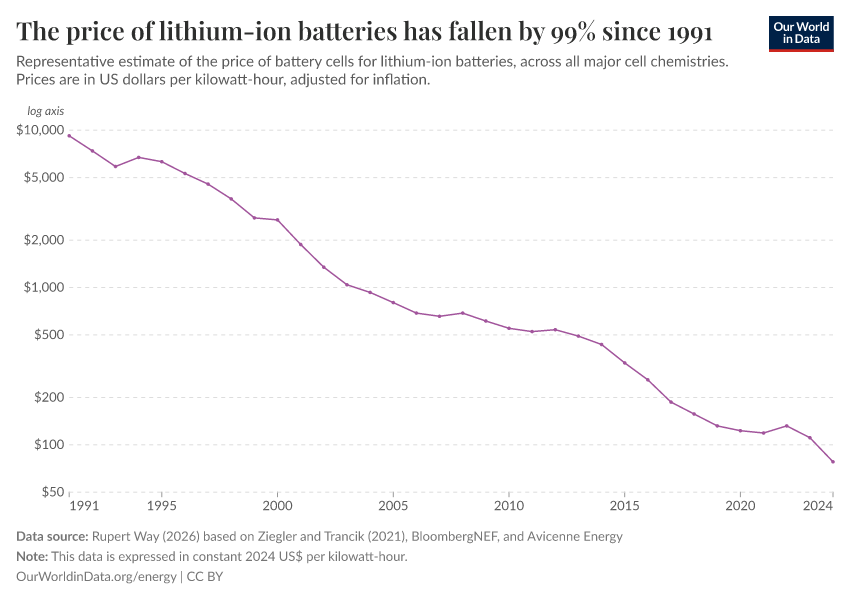
The chart below shows the decline in lithium-ion battery cell prices since 1991. Note that this is shown on a logarithmic scale.
The price declined by more than 99%. In 1991, lithium-ion batteries cost around $9,200 per kilowatt-hour — 33 years later, they cost just $78.
Let’s put that in perspective. The battery cells you’d find in a standard electric car today, which give around 220 to 250 miles (350 to 400 kilometers) of range, cost around $5,000.2
Just a decade ago, this would have cost over $20,000, as much as many would pay for the entire car itself. And back in 1991, almost $600,000.3
What’s promising is that the drop in prices continues: they’ve fallen by a third in just the last few years.
Why have prices fallen?
How did batteries get so much cheaper?
For technologies like batteries, prices fall with production. That's because they follow a learning curve: as cumulative production grows, innovators and engineers find incremental improvements in chemistry, manufacturing, and supply chains, driving a continuous fall in prices. Batteries did not become cheaper because of one big breakthrough, but thanks to thousands of small ones.
In the chart below, we’ve plotted the price of lithium-ion batteries against their cumulative production globally. Both axes are logarithmic.
Back in 1991, the market was tiny: just 130 kilowatt-hours had been produced worldwide. Just enough to power two of today's electric cars. Since then, production has grown dramatically, and as more batteries were produced, prices fell (which in turn created more demand and further increased production). By the end of 2023, global cumulative production had increased by a factor of 27 million from 1991 levels.
In the early 1990s, the price decline was much slower than you see for the rest of the curve. This was for several reasons. The market at the time was incredibly immature and relied on expensive and niche supply chains. The electronics company Sony largely held a monopoly over early technology, reducing market competition and making cost reductions a lower priority than improvements in scaling, safety, and battery lifespan.
Between 1991 and 2023, global cumulative production increased by a factor of 27 million.
It wasn’t until the late 1990s that other competitors — particularly South Korean brands such as Samsung and LG, and later Chinese manufacturers — entered the market, which brought fierce price competition and large-scale automated production.
From 1998 onwards, every time the global cumulative battery production doubled, the price dropped by roughly 19%. This is similar to the learning rate of solar panels; every time global production doubled, prices fell by around 20%.
Not all of this progress was driven by innovation for electric transport and renewable energy. In the 1990s and early 2000s, the main market for lithium-ion batteries was consumer electronics. The development of smaller batteries in products such as phones and laptops came first; only later did they become viable for cars, buses, and larger energy storage.
But price was not the only barrier. Falling costs were needed to make electric vehicles affordable, and better energy density was needed to make them practical. This energy density — how much electrical energy a battery can store for its volume — has more than tripled since the 1990s.4
Every time the global cumulative battery production has doubled, the price has dropped by roughly 19%.
That means more energy for less space and weight. Cars can now have larger batteries with enough capacity to go hundreds of miles without becoming impractically heavy or inefficient. Lighter batteries open up opportunities for the electrification of trucks, and even small airplanes and ships, where weight is crucial.5
The huge decline in the cost of solar power — particularly during the 2010s — transformed it from one of the most expensive sources of electricity to the cheapest. What has been missing, not only for the deployment of renewable energy but for the takeoff of electrified transport, has been cheap storage.
That cheaper storage is now arriving. Three decades ago, lithium-ion batteries were a niche technology for mobile phones and early laptops. Today, they power tens of millions of cars and store electricity in homes and on power grids worldwide.
The half-a-million-dollar battery was never going to transform transport. The $5,000 battery is.
Acknowledgments
Many thanks to Max Roser and Edouard Mathieu for editorial feedback and comments on this article, and to Marwa Boukarim for design help with the visualizations.
Learning curves: What does it mean for a technology to follow Wright’s Law?
Technologies that follow Wright’s Law get cheaper at a consistent rate, as the cumulative production of that technology increases.
Why did renewables become so cheap so fast?
In most places, power from new renewables is now cheaper than new fossil fuels.
Tracking global data on electric vehicles
Explore data on electric car sales and stocks worldwide.
Endnotes
Some of the bestselling electric cars in China are sold locally for the equivalent of around $10,000. In other markets, they would be more expensive.
Standard electric cars in a country like the United Kingdom tend to cost somewhere between $35,000 and $45,000. Smaller cars are a bit cheaper.
Electric cars vary in the size of their battery, ranging from just a few tens of kilowatt-hours for small cars designed for city-driving, to over 100 kWh for long-range cars. The average car sold today is somewhere in the range of 50 to 80 kWh.
To calculate the cost, I’ve assumed the battery is 63 kWh. 63 kWh multiplied by $78 per kWh = $4,914. Once you include the rest of the battery pack — cooling systems, casing, and electronics — it might have been as much as $6,000 or $7,000.
The typical efficiency of an electric car is around 3.5 to 4 miles per kWh. That gives a stated range of around 221 to 252 miles for a 63 kWh battery. Depending on driving style, speed, and weather, the real-world range can be around 20% lower than the advertised range.
9,210 per kWh = $580,000.
For the entire battery pack, it’s probably around $6,000 or $7,000.
63 kWh multiplied by $9,210 per kWh = $580,000. Again, once you include the rest of the battery pack, it might have been as much as $800,000.
In 1991, you could only get 200 watt-hours of capacity per liter of battery. You can now get over 700 watt-hours.
Ziegler, M. S., & Trancik, J. E. (2021). Re-examining rates of lithium-ion battery technology improvement and cost decline. Energy & Environmental Science.
Davis, S. J., Lewis, N. S., Shaner, M., Aggarwal, S., Arent, D., Azevedo, I. L., ... & Caldeira, K. (2018). Net-zero emissions energy systems. Science.
Finger, D. F., Braun, C., & Bil, C. (2020). Impact of battery performance on the initial sizing of hybrid-electric general aviation aircraft. Journal of Aerospace Engineering.
Cite this work
Our articles and data visualizations rely on work from many different people and organizations. When citing this article, please also cite the underlying data sources. This article can be cited as:
Hannah Ritchie and Pablo Rosado (2026) - “Battery costs have declined by 99% in the last three decades, making electrified transport a reality” Published online at OurWorldinData.org. Retrieved from: 'https://archive.ourworldindata.org/20260330-134943/battery-price-decline.html' [Online Resource] (archived on March 30, 2026).BibTeX citation
@article{owid-battery-price-decline,
    author = {Hannah Ritchie and Pablo Rosado},
    title = {Battery costs have declined by 99% in the last three decades, making electrified transport a reality},
    journal = {Our World in Data},
    year = {2026},
    note = {https://archive.ourworldindata.org/20260330-134943/battery-price-decline.html}
}
Reuse this work freely
All visualizations, data, and code produced by Our World in Data are completely open access under the Creative Commons BY license. You have the permission to use, distribute, and reproduce these in any medium, provided the source and authors are credited.
The data produced by third parties and made available by Our World in Data is subject to the license terms from the original third-party authors. We will always indicate the original source of the data in our documentation, so you should always check the license of any such third-party data before use and redistribution.
All of our charts can be embedded in any site.