
Data

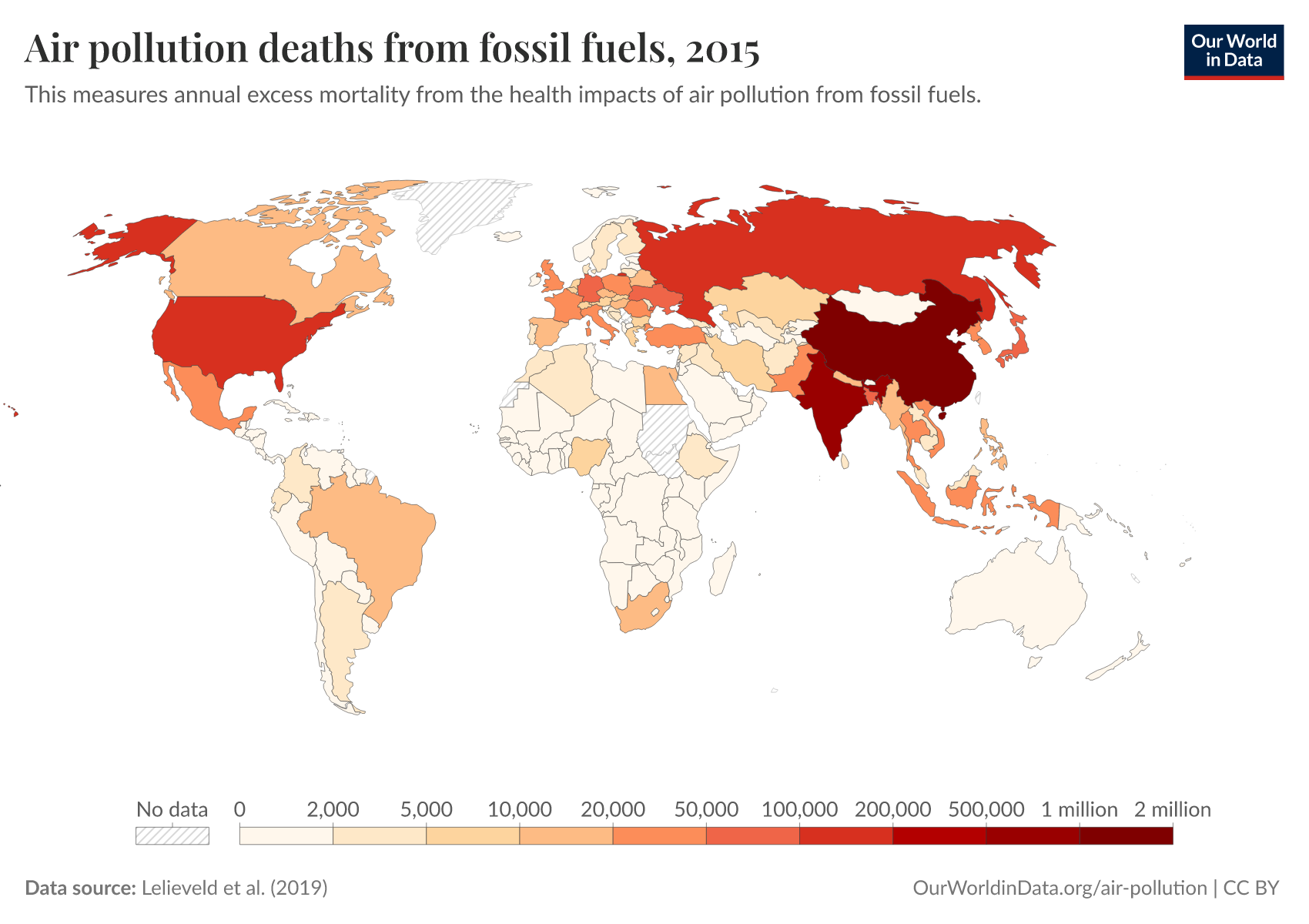
Air pollution deaths from fossil fuels

About this data

Source
Lelieveld et al. (2019)processed by Our World in Data
Last updated
November 17, 2020
Date range
2015–2015
Unit
deaths

Sources and processing

Lelieveld et al. – Effects of fossil fuel and total anthropogenic emission removal on public health and climate

Lelieveld et al. (2019) quantify excess mortality and years of life lost (YLL) from air pollution.

They do this by applying an atmospheric chemistry–general circulation model to calculate the impacts of air pollution on climate and public health. This model includes concentrations of ozone (O3) and particulate matter, including PM2.5. These concentrations are then used to convert to health burden based on the Global Burden of Disease methodology.

– Air pollution deaths from all sources includes pollution from all anthropogenic sources (fossil fuels, agriculture, residential energy use, and non-fossil industrial emissions) and natural emissions from sources such as desert dust. – Air pollution deaths from fossil fuels includes local air pollution generated from the burning of coal, oil and gas. – Air pollution deaths from all anthropogenic sources includes pollution from fossil fuels plus agriculture, residential energy use, and non-fossil industrial emissions.

Our World in Data has also converted these mortality and YLL metrics into rates based on the population figures included in the study's Supplemental material.

Our World in Data has also calculated fossil fuel and total anthropogenic pollution deaths as a share of total air pollution deaths based on the paper's original data.

Retrieved on
November 17, 2020
Citation
This is the citation of the original data obtained from the source, prior to any processing or adaptation by Our World in Data. To cite data downloaded from this page, please use the suggested citation given in Reuse This Work below.
Lelieveld, J., Klingmüller, K., Pozzer, A., Burnett, R. T., Haines, A., and Ramanathan, V. (2019). Effects of fossil fuel and total anthropogenic emission removal on public health and climate. Proceedings of the National Academy of Sciences, 116(15), 7192-7197.

Lelieveld et al. (2019) quantify excess mortality and years of life lost (YLL) from air pollution.

They do this by applying an atmospheric chemistry–general circulation model to calculate the impacts of air pollution on climate and public health. This model includes concentrations of ozone (O3) and particulate matter, including PM2.5. These concentrations are then used to convert to health burden based on the Global Burden of Disease methodology.

– Air pollution deaths from all sources includes pollution from all anthropogenic sources (fossil fuels, agriculture, residential energy use, and non-fossil industrial emissions) and natural emissions from sources such as desert dust. – Air pollution deaths from fossil fuels includes local air pollution generated from the burning of coal, oil and gas. – Air pollution deaths from all anthropogenic sources includes pollution from fossil fuels plus agriculture, residential energy use, and non-fossil industrial emissions.

Our World in Data has also converted these mortality and YLL metrics into rates based on the population figures included in the study's Supplemental material.

Our World in Data has also calculated fossil fuel and total anthropogenic pollution deaths as a share of total air pollution deaths based on the paper's original data.

Retrieved on
November 17, 2020
Citation
This is the citation of the original data obtained from the source, prior to any processing or adaptation by Our World in Data. To cite data downloaded from this page, please use the suggested citation given in Reuse This Work below.
Lelieveld, J., Klingmüller, K., Pozzer, A., Burnett, R. T., Haines, A., and Ramanathan, V. (2019). Effects of fossil fuel and total anthropogenic emission removal on public health and climate. Proceedings of the National Academy of Sciences, 116(15), 7192-7197.

All data and visualizations on Our World in Data rely on data sourced from one or several original data providers. Preparing this original data involves several processing steps. Depending on the data, this can include standardizing country names and world region definitions, converting units, calculating derived indicators such as per capita measures, as well as adding or adapting metadata such as the name or the description given to an indicator.

At the link below you can find a detailed description of the structure of our data pipeline, including links to all the code used to prepare data across Our World in Data.

Read about our data pipeline

How to cite this page

To cite this page overall, including any descriptions, FAQs or explanations of the data authored by Our World in Data, please use the following citation:

“Data Page: Air pollution deaths from fossil fuels”. Our World in Data (2026). Data adapted from Lelieveld et al.. Retrieved from https://archive.ourworldindata.org/20260511-092124/grapher/pollution-deaths-from-fossil-fuels.html [online resource] (archived on May 11, 2026).

How to cite this data

In-line citationIf you have limited space (e.g. in data visualizations), you can use this abbreviated in-line citation:

Lelieveld et al. (2019) – processed by Our World in Data

Full citation

Lelieveld et al. (2019) – processed by Our World in Data. “Air pollution deaths from fossil fuels” [dataset]. Lelieveld et al., “Effects of fossil fuel and total anthropogenic emission removal on public health and climate” [original data]. Retrieved May 13, 2026 from https://archive.ourworldindata.org/20260511-092124/grapher/pollution-deaths-from-fossil-fuels.html (archived on May 11, 2026).

Quick download

Download the data shown in this chart as a ZIP file containing a CSV file, metadata in JSON format, and a README. The CSV file can be opened in Excel, Google Sheets, and other data analysis tools.

Data API

Use these URLs to programmatically access this chart's data and configure your requests with the options below. Our documentation provides more information on how to use the API, and you can find a few code examples below.

Data URL (CSV format)
https://ourworldindata.org/grapher/pollution-deaths-from-fossil-fuels.csv?v=1&csvType=full&useColumnShortNames=false
Metadata URL (JSON format)
https://ourworldindata.org/grapher/pollution-deaths-from-fossil-fuels.metadata.json?v=1&csvType=full&useColumnShortNames=false

Code examples

Examples of how to load this data into different data analysis tools.

Excel / Google Sheets
=IMPORTDATA("https://ourworldindata.org/grapher/pollution-deaths-from-fossil-fuels.csv?v=1&csvType=full&useColumnShortNames=false")
Python with Pandas
import pandas as pd
import requests

# Fetch the data.
df = pd.read_csv("https://ourworldindata.org/grapher/pollution-deaths-from-fossil-fuels.csv?v=1&csvType=full&useColumnShortNames=false", storage_options = {'User-Agent': 'Our World In Data data fetch/1.0'})

# Fetch the metadata
metadata = requests.get("https://ourworldindata.org/grapher/pollution-deaths-from-fossil-fuels.metadata.json?v=1&csvType=full&useColumnShortNames=false").json()
R
library(jsonlite)

# Fetch the data
df <- read.csv("https://ourworldindata.org/grapher/pollution-deaths-from-fossil-fuels.csv?v=1&csvType=full&useColumnShortNames=false")

# Fetch the metadata
metadata <- fromJSON("https://ourworldindata.org/grapher/pollution-deaths-from-fossil-fuels.metadata.json?v=1&csvType=full&useColumnShortNames=false")
Stata
import delimited "https://ourworldindata.org/grapher/pollution-deaths-from-fossil-fuels.csv?v=1&csvType=full&useColumnShortNames=false", encoding("utf-8") clear