


 Kyrgyzstan Country Profile
CO₂ and Greenhouse Gas Emissions
Many of us want an overview of where our country stands on CO₂ and other greenhouse gas emissions. Are they increasing or decreasing? How do levels compare to other countries? This page provides the data for your chosen country across key metrics on this topic.
The data will be updated annually with the latest global and country emissions estimates.
How much CO₂ does Kyrgyzstan emit per person?
In Kyrgyzstan, CO₂ emissions per person were 1.64 tonnes in 2024.
Annual emissions figures are often used to compare countries’ contributions to climate change. But this metric often reflects differences in population size across the world.
To understand the ‘footprint’ of the average person in a given country, this chart shows per capita emissions. This is shown alongside countries with a similar level of income.
These figures reflect territorial emissions — emissions generated within a given country’s borders — so do not adjust for traded goods.

What are Kyrgyzstan’s total annual emissions?
A country’s total contribution to climate change is obviously its footprint per person, multiplied by its population. This is what the chart here shows. Again, this is shown alongside countries with a similar level of income.
Kyrgyzstan emitted 11.8 million tonnes of CO₂ in 2024.
These are territorial emissions, produced within the country’s borders. You will find consumption-based emissions, which adjust for imports and exports, later in this profile.

What share of global CO₂ emissions are emitted by Kyrgyzstan?
Looking at a country’s annual emissions is useful, but it can be hard to put these numbers in context. Is 10 million tonnes of CO2 large or small? What about 100 million or 1 billion tonnes?
This interactive chart shows annual emissions as a percentage of the global total in a given year.
Kyrgyzstan emitted 0.03% of the world’s CO2 emissions in 2024.

How much CO₂ has Kyrgyzstan produced historically?
When we only look at emissions produced today, we lack context for historical responsibility for emissions over recent decades or centuries.
This interactive chart shows cumulative CO2 emissions — the total emissions produced since 1751 up to the given year. This allows us to understand how much a given country has contributed to global emissions throughout its history. This is shown next to countries with a similar level of income today.
Kyrgyzstan has emitted 883 million tonnes, as of 2024.

What share of global historical CO₂ has Kyrgyzstan emitted?
Just as with annual emissions, simply presenting cumulative CO2 figures can be hard to contextualize. Has a given country’s contribution to the global total been large or small?
This chart shows the country’s cumulative emissions as a share of global cumulative emissions.
Kyrgyzstan has emitted 0.05% of global CO2 emissions since 1751.

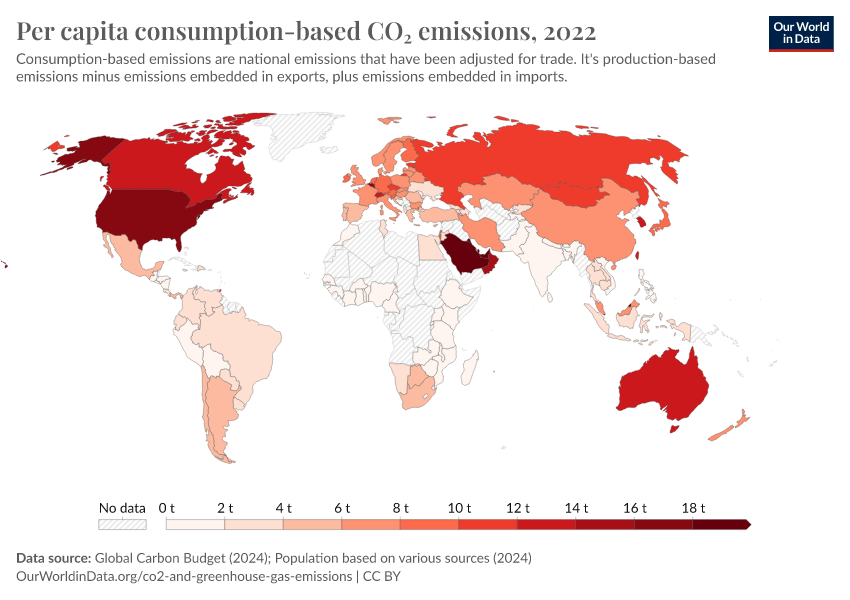
How do Kyrgyzstan’s emissions compare when we adjust for trade?
When countries set targets, measure or compare CO2 emissions, they tend to focus on territorial emissions, emitted within a country’s borders. However, this doesn’t capture emissions from traded goods — the CO2 emitted in the production of goods elsewhere, which are later imported (or the opposite: emissions from goods that are exported).
We can estimate consumption-based CO2 emissions by adjusting for trade. These emissions are shown in the interactive chart.
In $latestYear(consumption_emissions), Kyrgyzstan emitted 19.2 million tonnes of CO2, but when adjusted for trade, it emitted 11.8 million tonnes.

What share of Kyrgyzstan’s CO₂ emissions are produced from different fuels?
CO2 emissions are dominated by the burning of fossil fuels for energy production, and industrial production of materials such as cement.
What is the contribution of each fuel source to the country’s CO2 emissions?
This interactive chart shows the breakdown of annual CO2 emissions by source: either coal, oil, gas, cement production or gas flaring. This breakdown is strongly influenced by a country's energy mix and changes as it shifts to or away from a given energy source.

How are Kyrgyzstan’s CO₂ emissions from different fuels changing?
The chart above allows us to see the breakdown of CO2 emissions by fuel type. But it makes it more difficult to see the absolute change in particular fuel sources over time.
This interactive chart shows the same data — CO2 emissions from coal, oil, gas, cement and flaring — but as individual lines to see clearly how each is changing over time.

How much does the average person in Kyrgyzstan emit? Where do emissions come from?
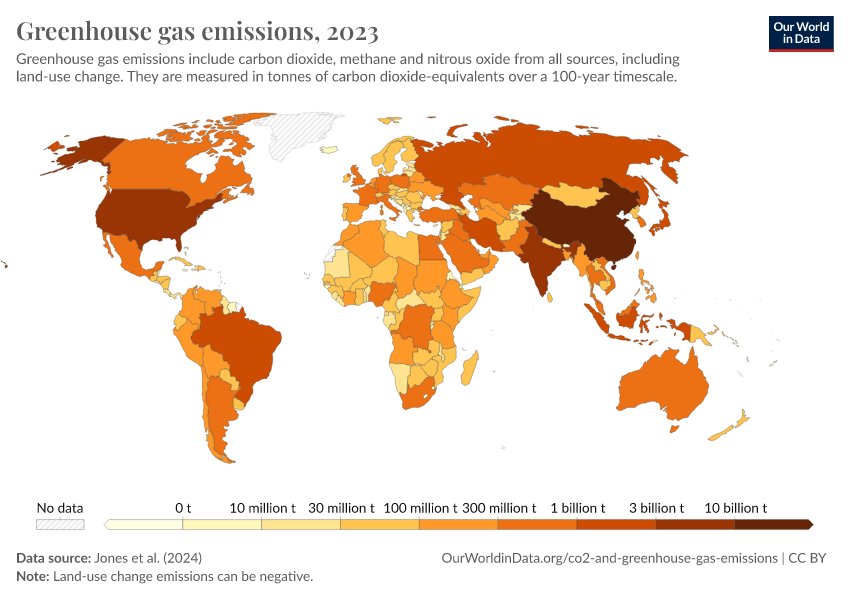
The charts above focused on carbon dioxide (CO2). But CO2 is not the only greenhouse gas. Others, including methane and nitrous oxide, have also had a significant impact on global warming to date.
The first interactive chart shows per capita greenhouse gas emissions. This is measured as the sum of all greenhouse gases, and given by a metric called ‘carbon dioxide equivalents’.
‘Carbon dioxide equivalents’ try to correct for the fact that one unit (e.g. a tonne) of a given gas doesn’t have the same impact on warming as another. We therefore multiply the emissions of each gas by its ‘global warming potential’ (GWP) value: this measures the amount of warming one tonne of that gas would create relative to one tonne of CO2.
In 2024, the average person in Kyrgyzstan emitted 3.1 tonnes of carbon dioxide equivalents (CO2eq).
The other interactive chart shows the sources of these emissions and the contribution of each sector.


Methane: how much does the average person in Kyrgyzstan emit? Where do emissions come from?
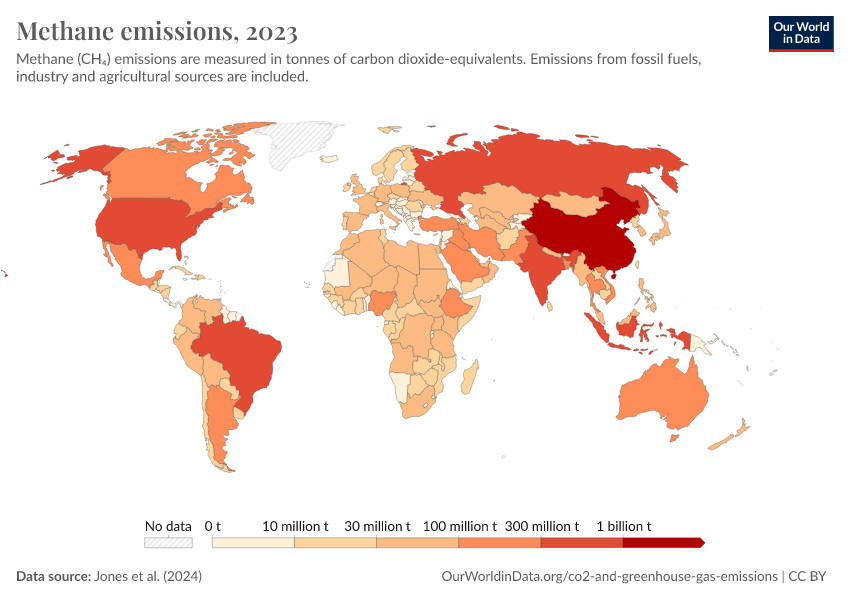
Methane (CH4) is a strong greenhouse gas, mainly produced through agricultural activities (e.g. livestock and rice production), in addition to leakages from oil and gas production (called ‘fugitive emissions’).
This first interactive chart here shows per capita emissions of methane each year. This is measured in ‘carbon dioxide equivalents’.
The other interactive chart shows the sources of these emissions and the contribution of each sector.


Nitrous oxide: how much does the average person in Kyrgyzstan emit? Where do emissions come from?
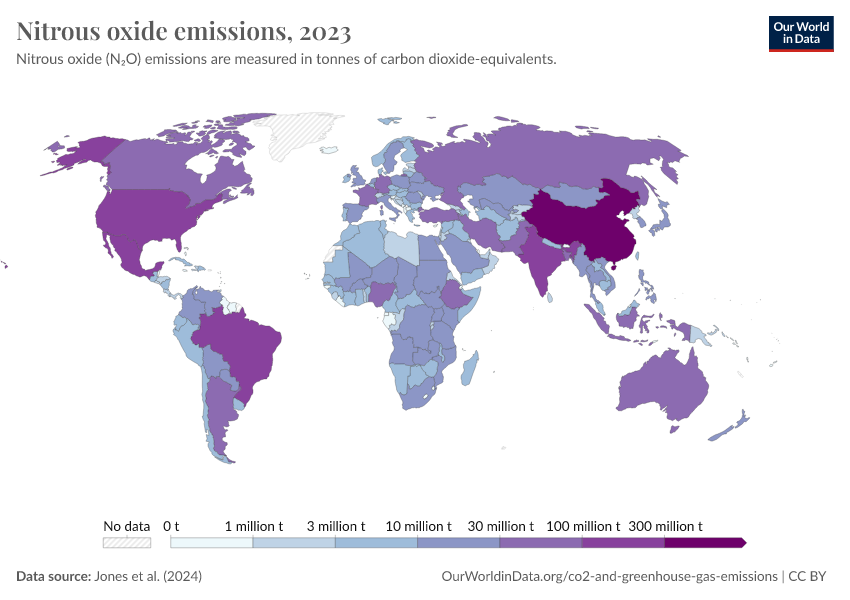
Nitrous oxide (N2O) is a strong greenhouse gas that is mainly produced from agricultural activities (e.g. from the use of synthetic and organic fertilizers to grow crops).
This first interactive chart here shows per capita emissions of nitrous oxide each year. This is measured in ‘carbon dioxide equivalents’.
The other interactive chart shows the sources of these emissions and the contribution of each sector.


Energy intensity: how much energy does Kyrgyzstan use per unit of GDP?
Energy is a large contributor to CO2 emissions, but it also matters for human development and rising living standards.
Energy intensity can therefore be a useful metric to monitor. Energy intensity measures the amount of energy consumed per unit of gross domestic product. It effectively measures how efficiently a country uses energy to produce a given amount of economic output. A lower energy intensity means it needs less energy per unit of GDP.
This interactive chart shows energy intensity, alongside countries with a similar level of income.
In 2022, Kyrgyzstan used 1.67 kWh of energy per unit of GDP.

Carbon intensity: how much carbon does Kyrgyzstan emit per unit of energy?
Energy intensity — shown in the chart above — is an important metric for monitoring whether countries are making progress in reducing emissions. Another is carbon intensity: the amount of CO2 emitted per unit of energy.
As we transition our energy mix towards lower-carbon sources (such as renewables or nuclear energy), the amount of carbon we emit per unit of energy should fall.
This chart shows carbon intensity.
In 2024, Kyrgyzstan emitted 214.06 kilograms of CO2 per kilowatt-hour.

Has Kyrgyzstan’s economic growth decoupled from its CO₂ emissions?
To reduce emissions and achieve increasing prosperity at the same time, we have to decouple economic growth from CO2 emissions. Several countries have achieved this in recent years.
The chart here shows whether this country has achieved this by showing the change in GDP per capita, and annual per capita CO2 emissions over time.
We show both territorial and consumption-based emissions (where available). This allows us to see whether the import of production from other countries — or the export to other countries — has affected this change in emissions.

Cite this work
Our articles and data visualizations rely on work from many different people and organizations. When citing this profile page, please also cite the underlying data sources. This profile page can be cited as:
Hannah Ritchie and Pablo Rosado (2025) - “CO₂ and Greenhouse Gas Emissions” Published online at OurWorldinData.org. Retrieved from: 'https://ourworldindata.org/profile/co2/kyrgyzstan' [Online Resource]BibTeX citation
@article{owid-co2-kyrgyzstan,
    author = {Hannah Ritchie and Pablo Rosado},
    title = {CO₂ and Greenhouse Gas Emissions},
    journal = {Our World in Data},
    year = {2025},
    note = {https://ourworldindata.org/profile/co2/kyrgyzstan}
}
Reuse this work freely
All visualizations, data, and articles produced by Our World in Data are completely open access under the Creative Commons BY license. You have the permission to use, distribute, and reproduce these in any medium, provided the source and authors are credited.
The data produced by third parties and made available by Our World in Data is subject to the license terms from the original third-party authors. We will always indicate the original source of the data in our documentation, so you should always check the license of any such third-party data before use and redistribution.
All of our charts can be embedded in any site.