


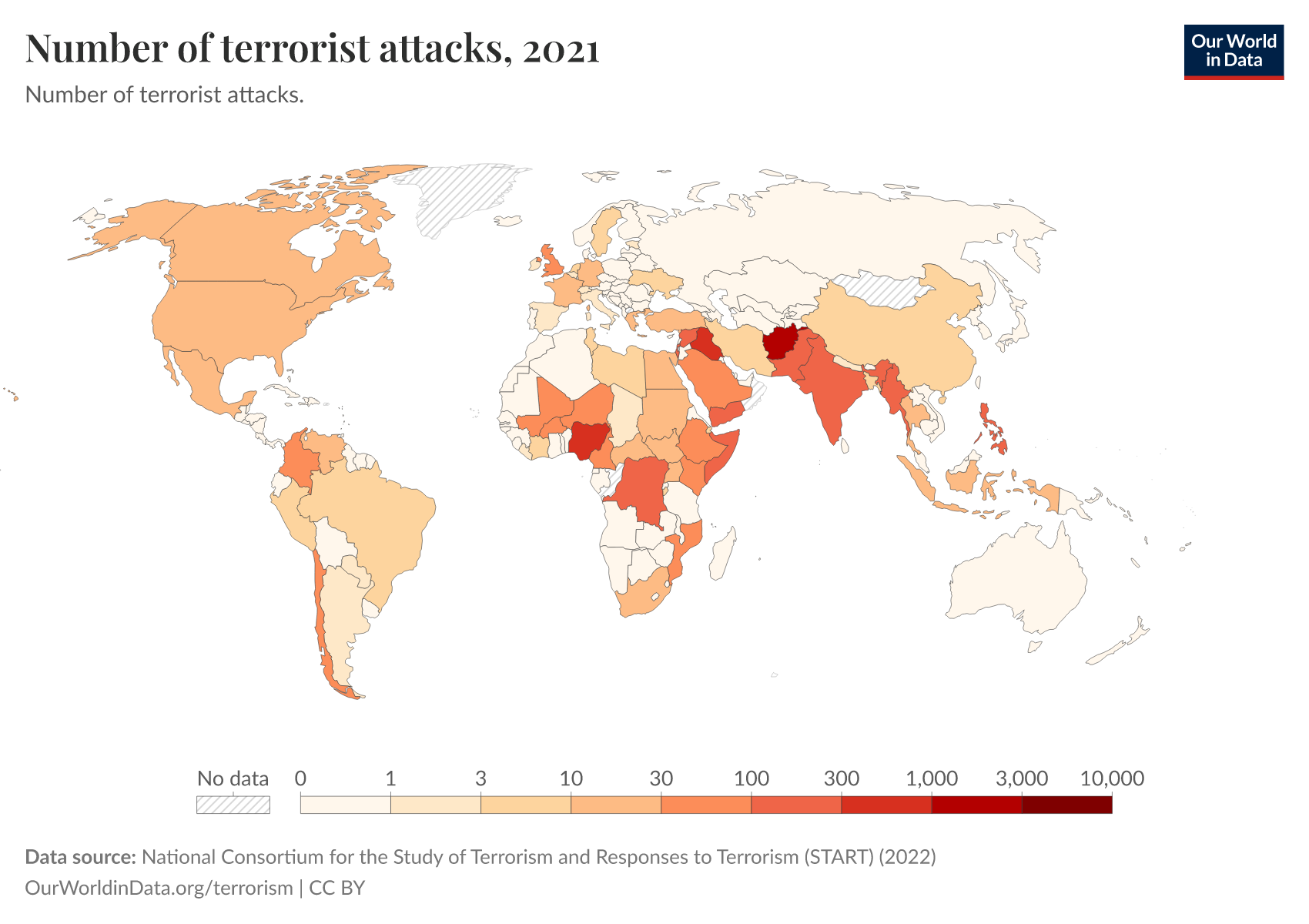
What you should know about this indicator
- The GTD defines a terrorist attack as the threatened or actual use of illegal force and violence by a non-state actor to attain a political, economic, religious, or social goal through fear, coercion, or intimidation. In practice this means in order to consider an incident for inclusion in the GTD, all three of the following attributes must be present:
- The incident must be intentional - the result of a conscious calculation on the part of a perpetrator.
- The incident must entail some level of violence or immediate threat of violence -including property violence, as well as violence against people.
- The perpetrators of the incidents must be sub-national actors. The database does not include acts of state terrorism. In addition, at least two of the following three criteria must be present for an incident to be included in the GTD:
- Criterion 1: The act must be aimed at attaining a political, economic, religious, or social goal. In terms of economic goals, the exclusive pursuit of profit does not satisfy this criterion. It must involve the pursuit of more profound, systemic economic change.
- Criterion 2: There must be evidence of an intention to coerce, intimidate, or convey some other message to a larger audience (or audiences) than the immediate victims. It is the act taken as a totality that is considered, irrespective if every individual involved in carrying out the act was aware of this intention. As long as any of the planners or decision-makers behind the attack intended to coerce, intimidate or publicize, the intentionality criterion is met.
- Criterion 3: The action must be outside the context of legitimate warfare activities. That is, the act must be outside the parameters permitted by international humanitarian law, insofar as it targets non-combatants.
- In some cases it's unclear whether an incident fully meets the criteria. In these borderline cases, terrorism is considered likely but not certain, and the incident is still included. For example, the GTD includes non-state attacks with political or ideological motives (from targeted killings and sabotage to 5G mast arson linked to conspiracy theories). It excludes state terrorism, lawful warfare, and non-political violence such as most U.S. school shootings, profit-driven crime, and personal disputes.
Related research and writing
Explore charts that include this data


More Data on Terrorism
Sources and processing
This data is based on the following sources
How we process data at Our World in Data
All data and visualizations on Our World in Data rely on data sourced from one or several original data providers. Preparing this original data involves several processing steps. Depending on the data, this can include standardizing country names and world region definitions, converting units, calculating derived indicators such as per capita measures, as well as adding or adapting metadata such as the name or the description given to an indicator.
At the link below you can find a detailed description of the structure of our data pipeline, including links to all the code used to prepare data across Our World in Data.
Reuse this work
Citations
How to cite this page
To cite this page overall, including any descriptions, FAQs or explanations of the data authored by Our World in Data, please use the following citation:
“Data Page: Number of terrorist attacks”, part of the following publication: Bastian Herre, Veronika Samborska, Hannah Ritchie, and Max Roser (2023) - “Terrorism”. Data adapted from National Consortium for the Study of Terrorism and Responses to Terrorism (START). Retrieved from https://archive.ourworldindata.org/20260910-000442/grapher/terrorist-attacks.html [online resource] (archived on September 10, 2026).How to cite this data
In-line citationIf you have limited space (e.g. in data visualizations), you can use this abbreviated in-line citation:
National Consortium for the Study of Terrorism and Responses to Terrorism (START) (2022) – with major processing by Our World in DataFull citation
National Consortium for the Study of Terrorism and Responses to Terrorism (START) (2022) – with major processing by Our World in Data. “Number of terrorist attacks” [dataset]. National Consortium for the Study of Terrorism and Responses to Terrorism (START), “Global Terrorism Database”; National Consortium for the Study of Terrorism and Responses to Terrorism (START), “Global Terrorism Database (2020–2021)” [original data]. Retrieved October 21, 2026 from https://archive.ourworldindata.org/20260910-000442/grapher/terrorist-attacks.html (archived on September 10, 2026).Download
Quick download
Download the data shown in this chart as a ZIP file containing a CSV file, metadata in JSON format, and a README. The CSV file can be opened in Excel, Google Sheets, and other data analysis tools.
Data API
Use these URLs to programmatically access this chart's data and configure your requests with the options below. Our documentation provides more information on how to use the API, and you can find a few code examples below.
Data URL (CSV format)
https://ourworldindata.org/grapher/terrorist-attacks.csv?v=1&csvType=full&useColumnShortNames=falseMetadata URL (JSON format)
https://ourworldindata.org/grapher/terrorist-attacks.metadata.json?v=1&csvType=full&useColumnShortNames=falseExcel / Google Sheets
=IMPORTDATA("https://ourworldindata.org/grapher/terrorist-attacks.csv?v=1&csvType=full&useColumnShortNames=false")Python with Pandas
import pandas as pd
import requests

# Fetch the data.
df = pd.read_csv("https://ourworldindata.org/grapher/terrorist-attacks.csv?v=1&csvType=full&useColumnShortNames=false", storage_options = {'User-Agent': 'Our World In Data data fetch/1.0'})

# Fetch the metadata
metadata = requests.get("https://ourworldindata.org/grapher/terrorist-attacks.metadata.json?v=1&csvType=full&useColumnShortNames=false").json()
R
library(jsonlite)

# Fetch the data
df <- read.csv("https://ourworldindata.org/grapher/terrorist-attacks.csv?v=1&csvType=full&useColumnShortNames=false")

# Fetch the metadata
metadata <- fromJSON("https://ourworldindata.org/grapher/terrorist-attacks.metadata.json?v=1&csvType=full&useColumnShortNames=false")
Stata
import delimited "https://ourworldindata.org/grapher/terrorist-attacks.csv?v=1&csvType=full&useColumnShortNames=false", encoding("utf-8") clear